podcasting with ra cook & ms doc brandon beaber

Multiple sclerosis challenges ranging from misdiagnoses and obtaining work accommodations, to advocating for chronic illness causes and writing from the patient perspective were chief among the many issues I recently discussed with two podcasters.

Southern California’s Dr. Brandon Beaber, a neurologist specializing in multiple sclerosis, chatted with me recently for his podcast about my new book, Uncomfortably Numb 2: An Anthology for Newly-Diagnosed MS Patients, touching on topics like when or whether to tell people you have MS and what lessons I’ve learned since I was diagnosed in 2014. Spoiler alert: There’ve been a lot of them.
Meanwhile, podcaster RA Cook, a fellow author and western Massachusetts native, hosted me as a guest on her podcast, Well Done You. Our wide-ranging conversation addressed topics like writing and teaching journalism at the university level, to being a multiple sclerosis patient and advocating for issues facing those living with chronic illnesses.

I was honored to be a part of both of their podcasts.

Be sure to follow Dr. Beaber’s podcasts here and RA Cook’s podcasts here.
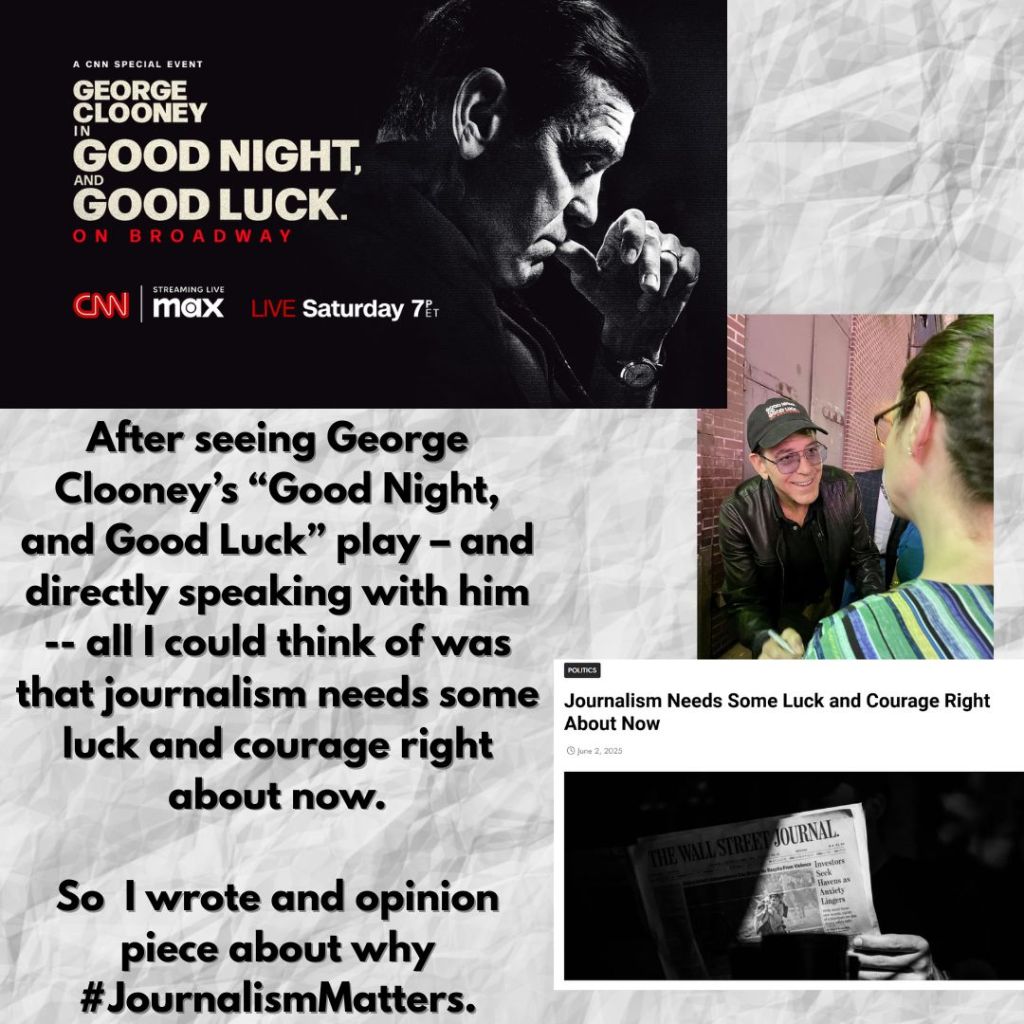
talkin’ ’bout journalistic courage

GirlTalkHQ recently published my essay about why journalistic courage matters right now, as journalism is being threatened at a moment when we need its skepticism and truth telling more than ever.

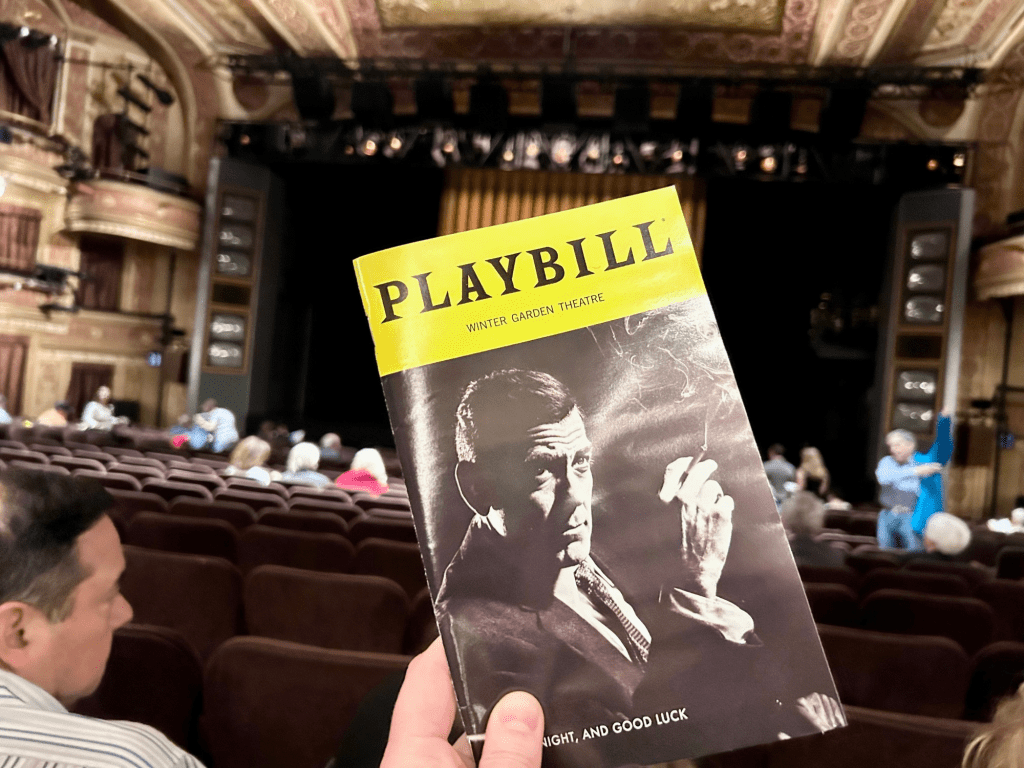
It was inspired by watching Tony-nominated actor George Clooney who I met in New York City after seeing his phenomenal play, Good Night, and Good Luck, about how a CBS journalist, Edward R. Murrow, sacrificed his career in order to speak truth to and about U.S. Sen. McCarthy.

The essay begins this way:

I didn’t want a selfie. I didn’t want to grab George Clooney’s hand. I just wanted to tell him something.

I stood on 7th Avenue in Manhattan at the end of a long line by the Winter Garden Theater’s stage door after having seen “Good Night, and Good Luck.” Clutching the play poster I’d purchased while I waited for its star and playwright, I wasn’t there to fangirl but to deliver a message: “I teach journalism and I very much appreciate this show and how you’re standing up for the importance of journalism.” 

With a black “Good Night, and Good Luck” baseball cap tucked low on his dyed-black hair and oversized, tinted aviator glasses covering a substantial portion of his face, Clooney, the son of a journalistsigned my poster and responded to my message saying, “Well I appreciate anyone who teaches journalism.”

You can read the rest of the piece here.

umass journalism hosts memoirists

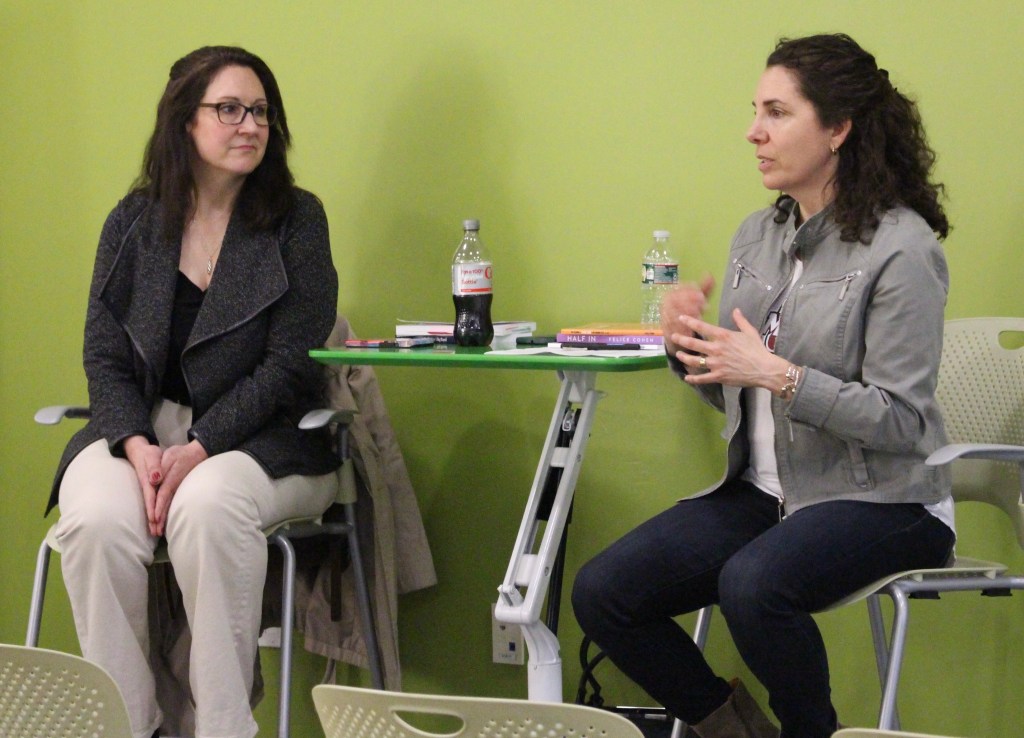
The UMass Journalism Department graciously invited my former UMass/Massachusetts Daily Collegian pal, the award-winning writer Felice Cohen, and me to talk about our experiences writing memoir.

In late April, Felice told attendees that her family read early drafts of her UMass-based memoir, Half In which reveals her 1990s love affair with a much older woman — and said they were supportive of her relating the truth of her experience. She said she heavily relied on the journals she kept during that time to refresh her memory about specific events and conversations, which, in the book, are very detailed. Felice is currently working on what she called a “reverse memoir” using letters she’s received throughout her life.

I, meanwhile, totally put my husband Scott on the spot and asked him what he thought about being portrayed and quoted in my memoir, Uncomfortably Numb, which traces the first several years of my life with multiple sclerosis. His reply? He trusts me (!) to tell my “truth” since I’ve been writing about my life –and, consequently, him — ever since we met when we were undergrads.

It was wild to look around the state-of-the-art Journalism Hub and to later visit the freakishly clean Collegian offices — which, years ago, moved out of its original location in the windowless Campus Center basement. Gone were the days of that smelly, lumpy sofa in the Journalism Department and of messy student newspaper offices with stacks of papers and all manner of wires snaking up the walls and across floors like out-of-control ivy.

Another major difference on the Amherst campus? The dining hall. Not necessarily the halls themselves, but the food within them which is now top notch, a far cry from when the chicken cutlet sandwiches were referred to as “chicken pucks” and the highlight of the week was when fried French toast sticks were on the menu. It’s no wonder why, when I asked my younger son who graduated last year, where we should go out to eat and he said, “The dining hall.”

disability justice project features meredith

I was honored to be invited to serve as a fellow for the Disability Justice Project. As part of my work with the group, I’ll serve as a mentor to a journalist as she works on journalistic projects.

Here’s how the group defines itself:

The Disability Justice Project (DJP) is a strategic partnership between the Disability Rights Fund, an international NGO funding grassroots organizations of persons with disabilities (OPDs) in the Global South, and journalism educator and human rights filmmaker Jody Santos and other nationally recognized media makers from Northeastern University’s School of Journalism in Boston, Massachusetts. Based on a fellowship model, newer professionals with lived experience of disability from the Global South are paired with mentors/professional journalists in the U.S. In an exchange of ideas and experiences, the fellows learn about digital storytelling from some of the best in the industry, while the mentors learn about the global disability justice movement from frontline activists – with the goal of incorporating that new understanding into their reporting for publications like The New York Times and The Guardian or for broadcasters like PBS and ABC.

The group recently ran a feature story about me as I’m writer and journalism faculty member who has a disability (multiple sclerosis). The article entitled, “Meet DJP Mentor Meredith O’Brien,” began:

Disability Justice Project mentor Meredith O’Brien has always loved reading and writing. “As a kid, I was often reading and trying my hand at writing little stories,” she says. “I’d find notebooks around the house and just start writing stories in them.”

teaching narrative nonfiction with bay path university’s mfa program

A beloved colleague of mine from my western Massachusetts newspaper reporting days — Suzanne Strempek Shea, with whom I used to work at the Springfield, Mass. newspaper — designed a wonderful Narrative Medicine area of study for Bay Path University’s Master of Fine Arts in Creative Nonfiction program.

It’s a new track in the MFA program (I earned my MFA in creative nonfiction there in 2017) and is also offered as a stand-alone certificate program. Last June, I participated in a Bay Path MFA webinar to discuss my 2020 medical memoir, Uncomfortably Numb, where Suzanne and I talked virtually about the book as well as narrative medicine.

Fast-forward to early February 2021: I was contacted by MFA Program Director Leanna James Blackwell and asked if I could take over the already-in-progress Intro to Narrative Medicine class because Suzanne had to take a temporary leave due to an injury. (This is such a weird confluence of events, an injury preventing her from teaching narrative medicine.) Luckily, I was already familiar with the Canvas learning management system which they utilize — also used by Northeastern University where I teach journalism classes — and had already read one of the main texts.

Now as I plan to have my second evening Zoom class with a group of seven writers, I finally feel as though I’ve got a handle on the class and its rhythm, and cannot wait for the rest of the semester to unfold as we devour Writing Hard Stories by Melanie Brooks, Bodies of Truth edited by Dinty W. Moore, Erin Murphy, et al., and engage with the students’ creative nonfiction work about issues of illness and trauma.

Meanwhile, we’re sending healing vibes to Suzanne!

teaching college journalism in the trump era

inside logoFor the past two years, an increasing number of my university students have been asking me whether what they’re seeing transpire between White House officials and members of the national news media is, for lack of a better word, “normal.”

They often refer to the death threats journalists like White House reporter April Ryan has received after being singled out by the president for verbal attacks. They talk about how the commander-in-chief routinely labels news reporters as the “enemy of the people” (a phrase applied by dictators like Stalin, as NPR’s Scott Simon said “to vilify their opponents … who were often murdered.”). They are aghast that the president once joked about killing journalists and routinely calls those who practice journalism as “fake.” During the presidential campaign, a Trump supporter wore a T-shirt to a Trump campaign rally suggesting that journalists be lynched.

I wrote a piece for the Inside Higher Ed website exploring my struggles with teaching students how to be savvy news consumers when things like basic facts are under assault.

You can read the full piece here.

Image credit: Inside Higher Ed.


2017-2018 southborough middle school group continues in ‘mr. clark’s big band’ tradition

The current Big Band members at the Trottier Middle School in Southborough, Mass. — led by the larger-than-life music director Mr. Clark, of Mr. Clark’s Big Band fame — are continuing to carry on the school’s tradition of sharing their music with their unique brand of unbridled enthusiasm.

33784860_2243272132366728_5795502403910369280_nThe Trottier Middle School’s Facebook page recently featured a video of the 2017-2018 Big Band playing “Uptown Funk” during a school assembly. Seeing the joy on the faces of the middle school students reminded me of the Big Band students I observed during 2012-2013 school year, whose journeys I chronicled in Mr. Clark’s Big Band: A Year of Laughter, Tears and Jazz in a Middle School Band Room. I really miss the time I spent in the Trottier band room observing Mr. Clark and those students hone their skills and tell really bad jokes.

However …  I’ll get an opportunity to revel in Big Band tunes during their June 14 Jazz Night performance at the Trottier Middle School at 7 p.m. Proceeds from the event will benefit the American Cancer Society.

You can get an audio preview of this year’s Big Band repertoire by listening to the middle school musicians perform on WICN 90.5 FM Jazz+ for New England on Howard Caplan’s “The Saturday Swing Session” on Saturday, June 9 between 11 a.m. and noon.

*To watch the video of “Uptown Funk” performance, click here*


talking student journalism at umass amherst

UMass Collegian panelI climbed into the mental “way-back” machine at UMass-Amherst over the weekend at a reunion of fellow alums who’d spent countless hours tucked away in the windowless Campus Center basement working on the university’s student newspaper, The Massachusetts Daily Collegian.

Invited to speak on a panel of alums — along with S.P. Sullivan, award-winning investigative journalist and Larry Bouchie, president of a public relations firm — we talked about our respective career paths, taking chances, and being willing to continually learn and update one’s skills. The intrepid B.J. Roche moderated. Meanwhile, the student editors schooled us as one introduced us to a new app (new to me anyway), Slack.

The afternoon event also included a keynote speech from Boston Herald sports columnist/UMass grad Steve Buckley, a discussion about local newspaper ownership in New England, and a presentation from the current Collegian editors on the publication’s evolution to a largely digital news outlet.

Image credit: Mark Curelop.

essay: what to tell my students about journalism as it’s under assault

Screenshot 2018-03-19 12.30.28The nonprofit, nonpartisan journalism think tank, the Poynter Institute, recently ran a column I wrote in response to news that reporters covering the mass shooting in Parkland, Florida were being sabotaged online by people posing as journalists on social media with the intent of further eroding the public’s trust in the news media. Given that those charged with gathering news and rooting out the truth are already under assault from those at the very highest levels of the U.S. government, the opening of this new front in the war against the news media is an unwelcome development.

A salient excerpt:

We are in a world where journalists don’t just have to worry about double-checking the information and material they gather via social media. They now have to worry about their identities being stolen and their work actively thwarted by nameless, faceless actors, hell-bent on discrediting journalism and journalists in real time.

Read the entire column here.

Image credit: Poynter Institute.