I want you all to know that I was so very dedicated to this project that I watched Liverpool take on Brentford on Nov. 12 at the end of a trip to the humid, overheated hellscape that is Florida (the weather didn’t get along well with my severe multiple sclerosis-heat sensitivity) as I sat in the car my husband Scott and I rented, while I sat in the airport, while I dragged my super-fatigued ass through said airport, and then as I sat my ass on an early-ish Delta flight back to Boston. The only parts of the game I missed were when I went through airport security and during the time it took to get settled in my seat and find the game on the plane’s channel guide.
In spite of my MS fatigue and mobility issues — as well as the fact that I hadn’t yet had any coffee — I was quite impressed with myself for making it a point to not only watch the game, but to also take some pretty thorough notes. The first thing that struck me as I tuned into the contest on my phone was that the energy thousands of miles and an ocean away on the Anfield pitch was the polar opposite of what I was feeling. Once we got to the airport, Scott dropped me off so he could return the rental car. I dragged our luggage inside and plopped myself onto seats in front of the Delta counters.
Early on in the game, the teeny tiny little figures of Virgil van Dijk and Mo Salah on my phone’s screen teamed up to make a series of plays that looked impressive, but didn’t yield any goals. Diogo Jota was as chippy with Brentford players as I felt toward the Sunshine State, eager to get out of an area where the weather literally affected my damaged brain and made me feel ill nearly the entire time I was there. Darwin Nunez, channeling the energy of two dozen espressos, managed to emerge from traffic in front of the Brentford Bees’ goal in the 22nd minute and land it in the back of the net. Alas. He was offside. Six minutes later, Nunez executed this amazing backwards-over-his–head kick (see below) that also sunk. But. Again. He was declared off side. When, a minute later, two Brentford players got tagged with yellow cards and Liverpool blew a free kick, an announcer said, “Nothing breaking for a Liverpool player yet.”
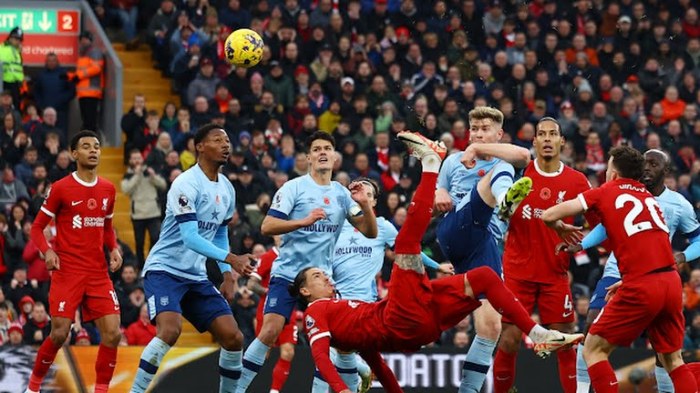
By the 37th minute, Scott walked through the airport doors, I handed him an earbud, and we joined the security line just in time to watch Joel Matip receive a warning from an official for colliding into a Brentford player and then get a yellow card for complaining. (It occurred to me that I was jealous of the officials’ power to walk around issuing cards to people who make with stupid complaints. That was be amazing.) Meanwhile, the Anfield chanted, “Bullshit,” while Scott and I argued about whether Matip deserved the card. If my Chelsea-mad son had been there, I’m certain he would’ve been very black-and-white about it, officiously telling me that Matip complained, complaining’s against the rules, therefore he deserved the yellow card. However he was back at home taking care of our two dogs which, he realized, isn’t so easy.
Just before Scott and I dumped our belongings onto the Transportation Security Administration’s (TSA) conveyor belts – I experienced a pang of worry about the safety of my laptop (the one on which I’m typing this very post) in the hands of Floridian TSA agents because, I suddenly remembered it bore a rainbow sticker saying, “Say gay, do crime” on it to protest Florida’s “Don’t Say Gay” law. (One TSA agent, to my shock, told me she liked the sticker.) – Mo Salah scored his 199th English football goal via a beautiful backward pass from Nunez. At the half it was 1-nil.
By the time Scott and I were able to return to the game, it was the 54th minute and officials were using VAR (video assistant referee … it’s a British phrase) to determine if Wataru Endo should get a red card for a slide-tackle where his studs wound up on top of a Brentford player’s foot/leg. However I didn’t totally hear most of the announcers’ commentary because I was wearing one ear bud (Scott had the other one) and there was incessant Charlie Brown’s-teacher-blathering from the gate attendants on the public address system. They’d overbooked our flight and were begging people to take the $500 gift card for another flight. How rude of them to talk over the Prem announcers!

Salah sunk his 200th British football goal in the 62nd minute but there was a question about whether Konstantinos Tsimikas was out-of-bounds when he passed the ball to Salah. (Reader: he was not.)
Both Scott and I shouted, “Wow” when Brentford’s goalie, David Raya, made an extraordinary save, looking like Superman as he went airborne. Minutes later, we again became noisy when Jota scored a bomb of a goal into the top, upper-right side of the goal, demonstrating “controlled strength,” an announcer said. No one in our seating area seemed to notice, particularly while this tiny, gray-black shaggy dog in a red harness was frolicking around the seating area. (I know I wasn’t the only one hoping the hound would be a silent traveler. On our way down to Florida, someone brought a dog who was clearly unhappy and barked for an extended period.)
Scott and I missed 14 minutes of the game due to the boarding process and, when we found the correct station on the seat-back TV (see above), the score was still 3-nil Liverpool, as it would remain for the rest of the match, including its six minutes of extra time. As the whistle blew, I heard Anfield filling with The Standells’ Boston-centric “Dirty Water,” the 1966 song usually played at Fenway Park after the Boston Red Sox win a game. Have they played this song all season and I never noticed? Did they start to play this after the Fenway Sports Group purchased Liverpool? (I shall explore these questions in a future post.)
International break, then a Nov. 25, 2023 draw with Man City
So, hear me out. I’m preemptively making excuses for my Nov. 25 mistake. While I was so proud of my valiant effort to make sure I saw as much of the Liverpool-Brentford game as I could even though I was traveling, I kind of fell on my face when it came to the 7:30 a.m. Liverpool game against Manchester City. I only saw half the game because I overslept. *Ducks to avoid the tomatoes being thrown at my head.*
I woke up at 8:20 and it was already halftime and Man City was up 1-nil. Ugh. Blame it on the two days of cooking before Thanksgiving dinner at my house and dessert at my brother’s. Blame it on spending nearly three hours on the following day watching and singing along with Taylor Swift’s Eras Tour movie with my daughter Abbey. I was beaten like the dozens of eggs we used during that week. (Bad mom joke, I know.) I arrived in the family room looking like a zombie, or, as my youngest son would say, like I need another hour of sleep. Jonah, who was staying over for a few days for the holiday, was already in the family room, while Scott was listening to the game in the adjacent kitchen as he prepared more stuffing because our family was having our second Thanksgiving dinner with his side of the family later that afternoon. Abbey, who came down with a head cold and missed Thanksgiving Part II, was watching the game in her bed.
Maybe it was my fuzzy-headedness, but as I watched the very physical play of Man City, I was captivated by the dude who looked like a Bond movie villain with slicked-back blond hair and grimace — Erling Haaland — who kept getting into tussles with Liverpool players, including one with Trent Alexander-Arnold that led to a free kick, which failed. Man City players were swarming Liverpool like annoying, powder blue gnats. And THEY aren’t the ones who have an insect nickname. (Their tenacity reminded me of the Roy Kent chant on Ted Lasso: “He’s here! He’s there! He’s every fucking where! Roy Kent!”)

The first thing I said out loud about the game came in the 67th minute when I asked if I’d remembered correctly that Liverpool usually fares poorly at early-morning matches. The Chelsea-mad son, who’d recently joined us in the family room, confirmed my memory saying that, yes, in the earlier matches, “They normally suck.”
One minute later … controversy. Man City scored a goal, but only after a player grabbed and held onto the shoulder of Liverpool goaltender Alisson Becker. Our family room descended into debate as some said the goal was legit and others disagreeing. The announcers were clearly in the “it’s a goal” camp. But they lost that argument.
Liverpool tied it up in the 80th with an Alexander-Arnold line-drive into the net after which he stood still and laid a single index finger across his lips to shush the Man City fans (see above), causing Jonah to leap off the couch, pump his balled right fist, and then high-five Scott and me. This set off a round of barking from our 12-pound caffeine-on-legs Jack Russell terrier who is offended by cheering or shouting of any kind. (Dude’s a super-sensitive soul, even though he murders fuzzy creatures like chipmunks and bunnies for sport.)
Liverpool Coach Jurgen Klopp’s substitutions at the 85th minute – bringing in Endo and Harvey Elliott and sending Nunez and Alexis MacAllister to the bench – yielded this gem from my Chelsea-fan son: “Endo and Elliott? How to lose the game 101? What are you smoking, Klopp? That’s not going to end well.”

Scott shook his head. “Endo scares me.”
“Yeah,” Chelsea boy said, “that’s what I said.”
Three yellow cards – two for Liverpool, one for Man City – followed a couple more concerning plays involving Becker, including on where a Man City player shoved him into the net after he grabbed the ball out of the air. As Becker fell to the ground in the 97th (!) minute, clutching the back of his right thigh, our living room fell silent at the prospect of an injured Becker.
“Oh, you’re getting relegated,” declared the Chelsea fan.
However, Becker eventually got back in goal, just as Haaland and his blond hair headed the ball (above) that, luckily, didn’t make its way into the net, leaving the score 1-1.
“All right!” shouted Jonah when the whistle blew. “I’m actually happy with a draw!”
Image credits: Google, me, Liverpool’s Instagram account, and Google.












 Meredith OBrien