My latest post for the National Multiple Sclerosis Society’s publication, Momentum Magazine, describes my initial reluctance — fueled by fear — to join an MS support group. But after attending several online support groups to promote my medical memoir, Uncomfortably Numb, I realized I was missing out.
Here’s how the piece begins:
I was diagnosed with relapsing-remitting multiple sclerosis in July 2014. Upon receiving my diagnosis, I reached out to the National MS Society for information. Included in the materials I received were contact details for MS support groups in my area. But despite the fact that I was perfectly able to attend a support group, I resisted.
Why?
I was petrified to sit, face-to-face, with my potential future.
I rang out the wretched 2020 and rang in 2021 with interviews about Uncomfortably Numb: a memoir with podcasters and the host of a YouTube series.
We talked about adjusting one’s life to an unexpected turn of events (like having the world shut down because of COVID, as well as, obviously, getting diagnosed with multiple sclerosis), the impulsive decisions we can make when we’re under stress (like “panic adopting” a puppy just months after getting diagnosed with MS, as many folks have done amid coronavirus shut-downs), and the impact of about writing about very personal topics.
Dianna Gunn, of the Spoonie Author Network — a network “devoted to sharing the stories of disabled, d/Deaf, neurodiverse authors (and/or authors who manage mental illness and/or chronic conditions) and educating abled people about what life is like for us as ‘Spoonie’ creatives” — conducted an interview with me where we discussed how a multiple sclerosis diagnosis upended my life and forced a stubborn me to pace myself when it came to my day’s activities (something with which I’ve had mixed results).
Weeks later, Chris Moore, of The Situation and the Story Podcast — which interviews authors about “the ways our various identities and intersectionalities inform our stories and make us who we are” — chatted with me about writing this intensely intimate memoir which covers rough emotional terrain, from my own illness and questions about who I’d be as a writer if some of my symptoms worsened, to the death of my mother with whom I had a challenging relationship.
Then I heard from a California-based neurologist who specializes in multiple sclerosis, Dr. Brandon Beaber, who asked if I’d speak with him about Uncomfortably Numb and my experiences as an MS patient.
Tatnuck Booksellers in Westborough, MA has signed copies of three of my books (a memoir, a novel and a work of nonfiction) for sale, just in time for the readers on your holiday lists. Given that COVID has severely affected small businesses like independent bookstores, I’m sure they’d appreciate your support.
Signed books include:
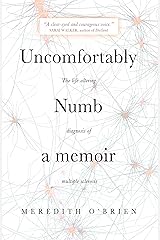
Uncomfortably Numb: a memoir. My medical memoir about the life-altering impact of a multiple sclerosis diagnosis. It chronicles the two years it took to get an MS diagnosis and confirmation that the symptoms I was experiencing weren’t simply in my imagination (as one physician suggested), as well as the uneasy piece I reached an uneasy peace with my post-MS life.
Mr. Clark’s Big Band: A Year of Laughter, Tears and Jazz in a Middle School Band Room. A book about the 2012-2013 school year I shadowed the Southborough, MA middle school jazz band as they were recovering from mourning the sudden death of one of their own, a 12-year-old trumpet player named Eric Green. This award-winning book would be great for any educators on your list.
Mortified: a novel about oversharing. Set in 2004 at the height of mommy blogging, this darkly humorous work of contemporary fiction follows a thirtysomething mom of two who started venting about her frustration with modern parenting through her blog. When her family discovers the unkind things she’s been writing about them online, well, all hell breaks loose.
Dianna Gunn recently interviewed me for her podcast, called the Spoonie Authors Podcast, a group which spotlights writers with disabilities.
For those who are unfamiliar with the phrase “spoonie,” the podcast offers this definition:
A Spoonie is a person who suffers from a chronic illness, condition, or disability that regularly drains them of their energy and/or causes acute pain, resulting in impaired function of ordinary activities. The nickname came from an article called The Spoon Theory by Christine Miserandino, which you can read on butyoudontlooksick.com. In my opinion, it’s still the best way to describe to non-Spoonies what life for us really feels like.
In The Spoon Theory, spoons are used as symbols for every-day activities, such as showering, making lunch, collecting the mail, and so on. Many of us don’t have enough ‘spoons’ to handle the simplest of routines.
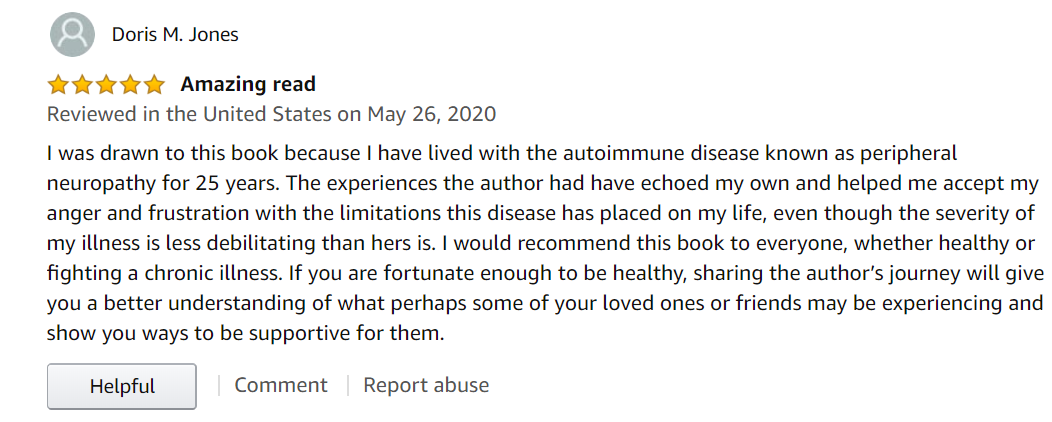
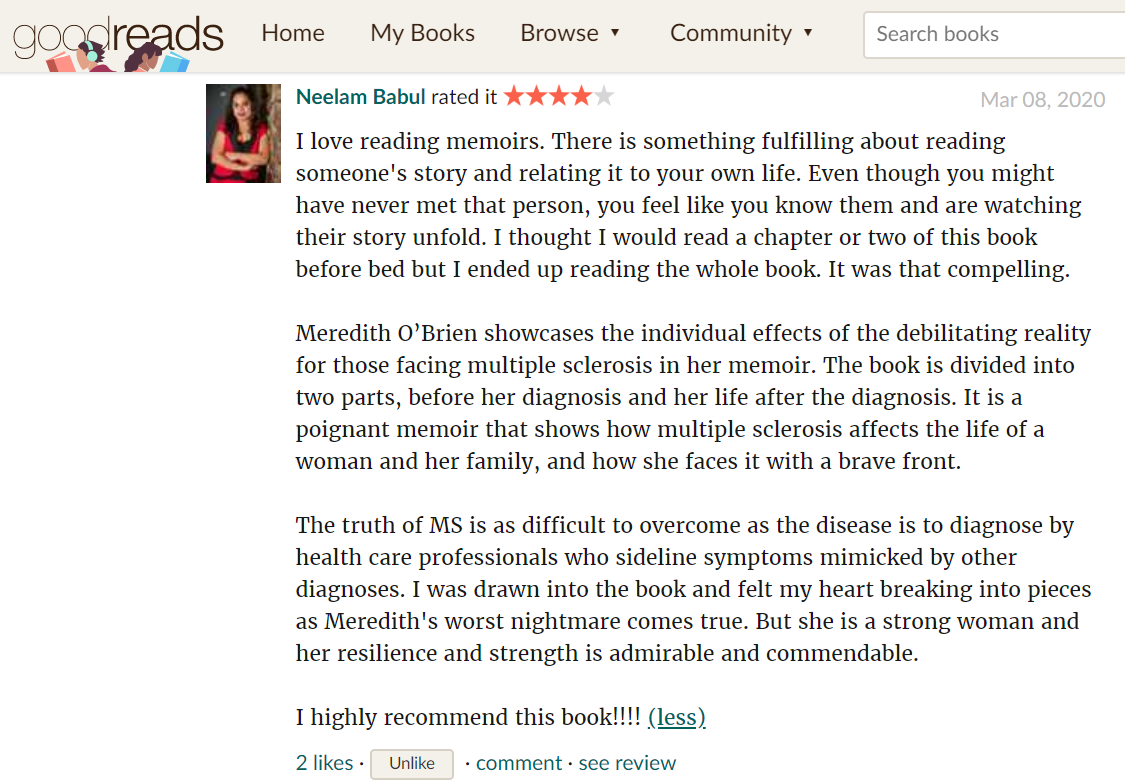
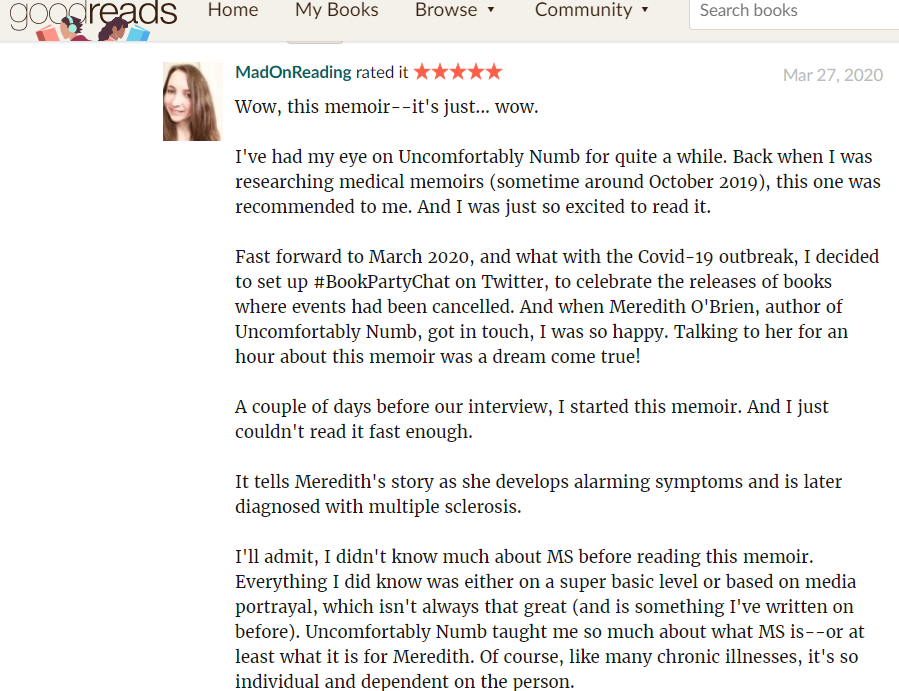
The Book Decoder blogger recently reviewed Uncomfortably Numb, calling it “inspiring.”
Here’s an excerpt:
I cried as I read Meredith’s prognosis. I don’t think I can ever express my feelings in words. Sometimes I wonder how our lives change within a fraction of a second. A diagnosis, untimely death – it’s as if, we were happy for a second and the next thing we know, we are hit by a freight train. It is easy to say “adjust to the new normal” or “learn to live with uncertainty” but it is not as easy as it sounds. Traumatic experiences make “adjusting” difficult.
The second week of July marked the first string of days this year where I could not go outside because of my multiple sclerosis-related heat sensitivity. What makes 2020 different from the five other summers in which I’ve dealt with this particular MS symptom? There’s a pandemic going on.
I wrote a piece for the website The Mighty about the confluence of the two illnesses. Here’s how it starts:
Today was the first summer day in 2020 when stepping outside the house made me feel as though I was going to vomit. The moderate heat, combined with high humidity, enveloped me and made me instantly feel ill.
Somewhere, deep inside my brain, signals went haywire. The temperature regulation area of my brain has been damaged by my relapsing remitting multiple sclerosis (MS), meaning I can’t tolerate heat and humidity. Subjecting my body to such conditions results in nausea and/or vomiting, dizziness, blurry vision with bright lights in the corners of my eyes, and a weakening of my legs, as though my thighs have been infused with Jell-O.
The Booksmith of San Francisco, partnering with the literary journal Zyzzya, hosted a lunchtime chat between journalist and Black Widow author Leslie Streeter and myself, members of Lockdown Literature, a group of authors whose books have been published amid the pandemic.
Leslie and I talked about the challenges of writing memoir, of worrying about revealing too much information, and about how writing our books — hers about her husband suddenly dying as the couple was in the midst of adopting a child, mine about the death of my mom and the loss of my health courtesy of my MS diagnosis — discuss how we’ve dealt with involuntary changes in our lives.
We both read aloud from sections of our book as well. The section that I read from my book was on the impulsive decision to adopt a second dog — Tedy — so I could focus on something other than death and illness. Ironically, during the COVID-19 pandemic, this is exactly what many others have done in the face of their own helplessness.
You can purchase both of our books via Booksmith, which proudly sells all of the books published by the Lockdown Literature authors.
Since then, I’ve had to not only adjust the way I move through the world, but have found myself educating others about what this incurable autoimmune disease is actually like.
It would make life a whole lot easier if a few things about multiple sclerosis (MS) became common knowledge. To that end, here’s what I wish everyone understood about MS.
This is the recording of my recent virtual author event with the Southborough (Mass.) Library where I read excerpts from my medical memoir, Uncomfortably Numb, and fielded questions from participants.
Thank you to Valerie and Ryan for their help in coordinating and running this event.



![Mortified: a book about oversharing by [Meredith O'Brien]](https://m.media-amazon.com/images/I/31Iw4r4L+-L.jpg)


 The Book Decoder blogger recently reviewed
 You can purchase both of our books via
  I recently wrote a post for the website
