genx & older millennials need a guide to parenting our parents

The Fort Worth Star-Telegram recently ran an opinion piece I wrote about the challenges faced by GenXers and older Millennials who are caring for aging parents, many of whom belong to the massive Baby Boomer generation that’s fond of drinking and predicted to develop dementia at higher rates than prior cohorts.

Here’s an excerpt:

All of us [GenXers] have arrived at the stage of our lives where we’ve become the glue holding the generations together. We host the holiday events. We keep everyone up-to-date on family news, like the family town crier. This being-the-glue-of-the-family seems to have happened slowly, then all at once. We went from being the ones with the lives built around raising our children and trying to advance our careers to the ones who’ve added parenting our parents to our to-do lists.

… Yet as we enter this new era of our lives, guidance is sparse. How-to books on raising kids tend to top out at the teenage years. There isn’t much guidance on how to give young adult children the support they need while simultaneously respecting their autonomy and trying not to anger them. Meanwhile, we’re doing the same thing with our parents, most of whom are living solo for the first time after decades of marriage. We’re trying to give them the support they need while simultaneously respecting their autonomy and trying not to anger them.

Read the full piece here.
podcasting with ra cook & ms doc brandon beaber

Multiple sclerosis challenges ranging from misdiagnoses and obtaining work accommodations, to advocating for chronic illness causes and writing from the patient perspective were chief among the many issues I recently discussed with two podcasters.

Southern California’s Dr. Brandon Beaber, a neurologist specializing in multiple sclerosis, chatted with me recently for his podcast about my new book, Uncomfortably Numb 2: An Anthology for Newly-Diagnosed MS Patients, touching on topics like when or whether to tell people you have MS and what lessons I’ve learned since I was diagnosed in 2014. Spoiler alert: There’ve been a lot of them.

Meanwhile, podcaster RA Cook, a fellow author and western Massachusetts native, hosted me as a guest on her podcast, Well Done You. Our wide-ranging conversation addressed topics like writing and teaching journalism at the university level, to being a multiple sclerosis patient and advocating for issues facing those living with chronic illnesses.

I was honored to be a part of both of their podcasts.

Be sure to follow Dr. Beaber’s podcasts here and RA Cook’s podcasts here.

talkin’ ’bout journalistic courage

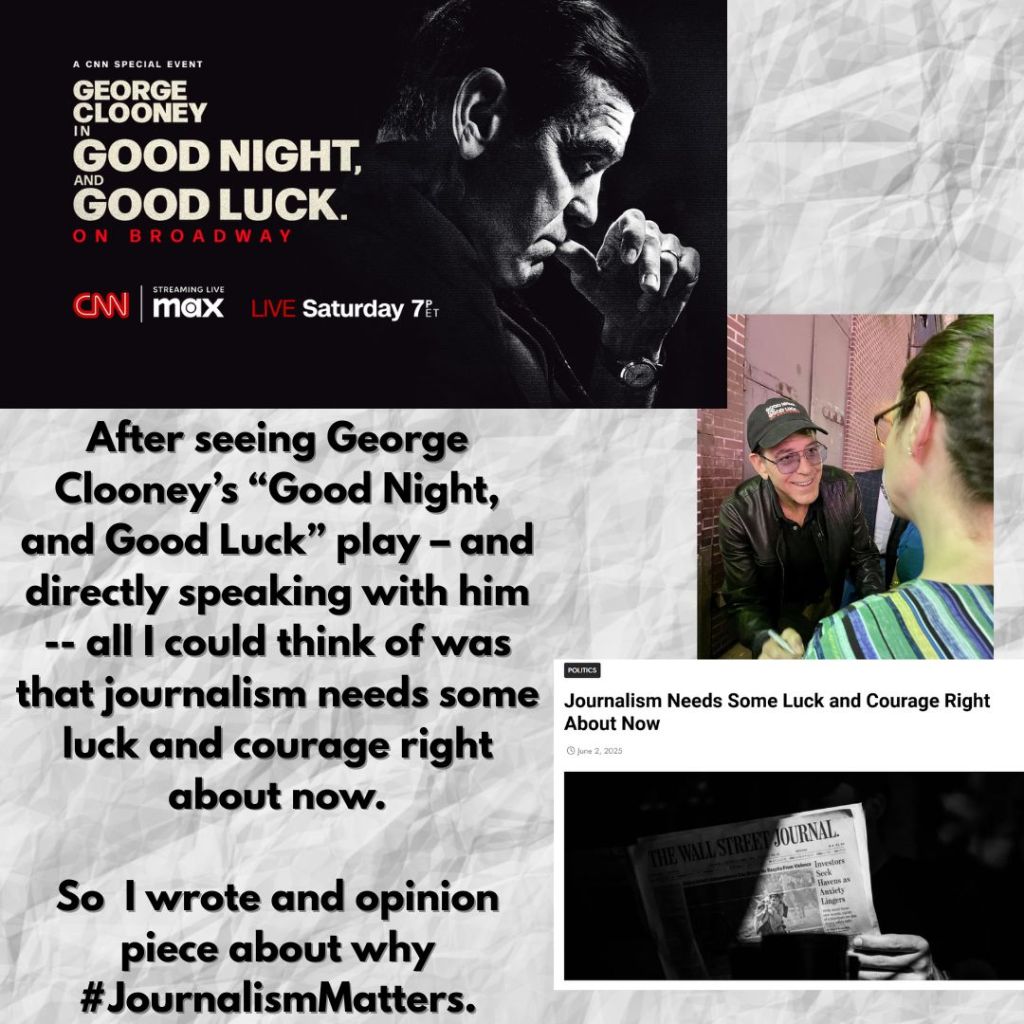
GirlTalkHQ recently published my essay about why journalistic courage matters right now, as journalism is being threatened at a moment when we need its skepticism and truth telling more than ever.

It was inspired by watching Tony-nominated actor George Clooney who I met in New York City after seeing his phenomenal play, Good Night, and Good Luck, about how a CBS journalist, Edward R. Murrow, sacrificed his career in order to speak truth to and about U.S. Sen. McCarthy.

The essay begins this way:

I didn’t want a selfie. I didn’t want to grab George Clooney’s hand. I just wanted to tell him something.

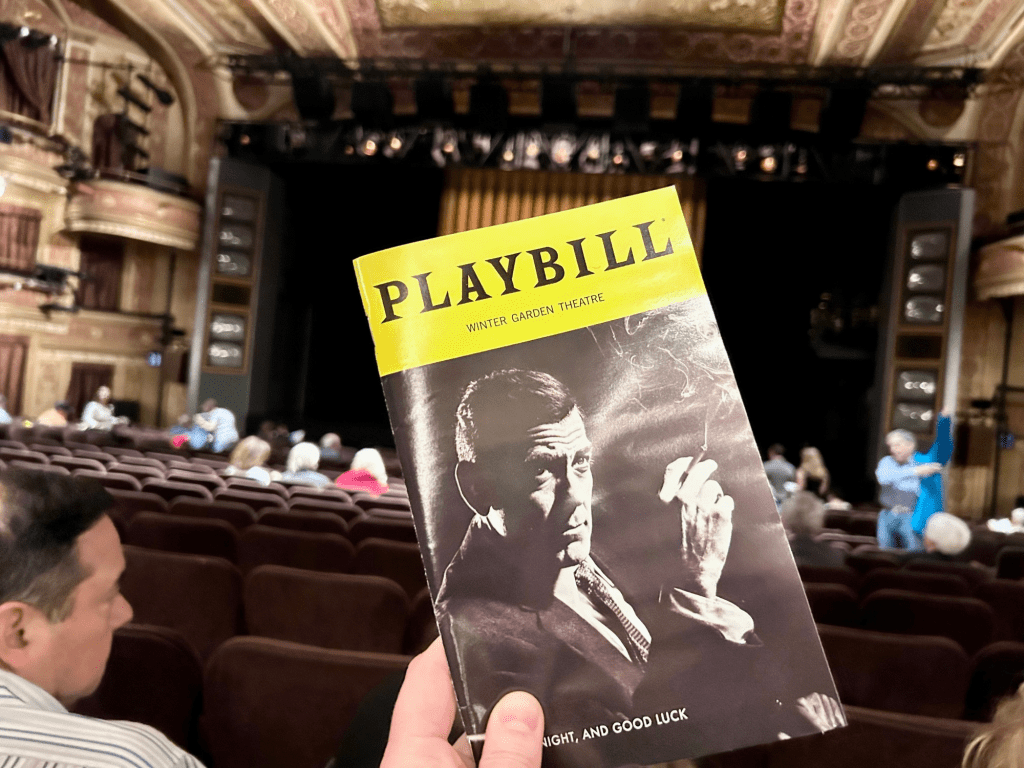
I stood on 7th Avenue in Manhattan at the end of a long line by the Winter Garden Theater’s stage door after having seen “Good Night, and Good Luck.” Clutching the play poster I’d purchased while I waited for its star and playwright, I wasn’t there to fangirl but to deliver a message: “I teach journalism and I very much appreciate this show and how you’re standing up for the importance of journalism.” 

With a black “Good Night, and Good Luck” baseball cap tucked low on his dyed-black hair and oversized, tinted aviator glasses covering a substantial portion of his face, Clooney, the son of a journalistsigned my poster and responded to my message saying, “Well I appreciate anyone who teaches journalism.”

You can read the rest of the piece here.

walk ms 2024: worcester & longmeadow

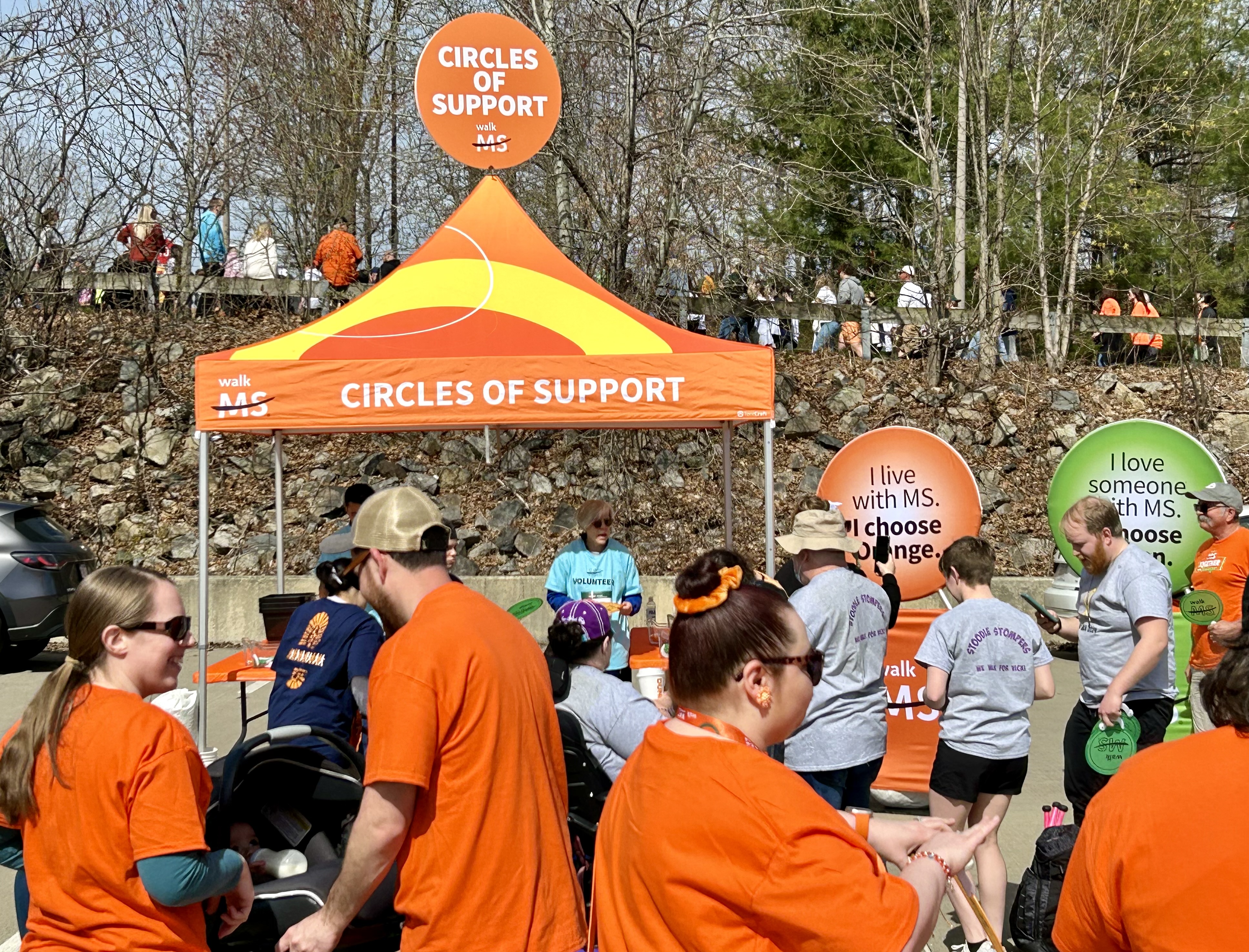
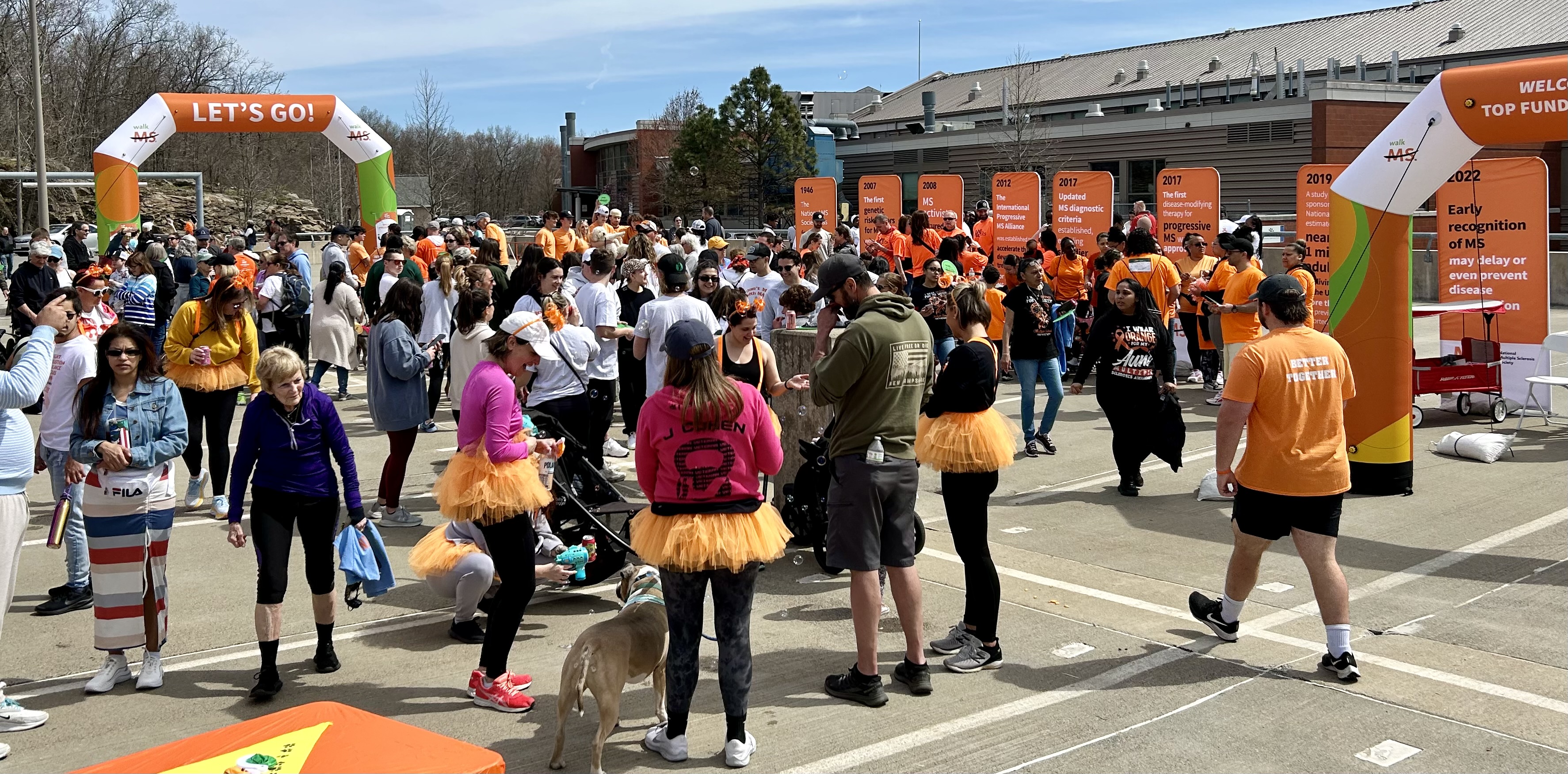
Some 700 walkers converged upon Worcester Technical High School on a warm Saturday morning in late April to raise awareness and money for multiple sclerosis research.

At Walk MS: Worcester, I had the privilege of hosting the event — using a finicky, hand-held mic which didn’t like the wind — where I was honored to spotlight a local woman’s story about her diagnosis of MS in the middle of the COVID-19 pandemic.

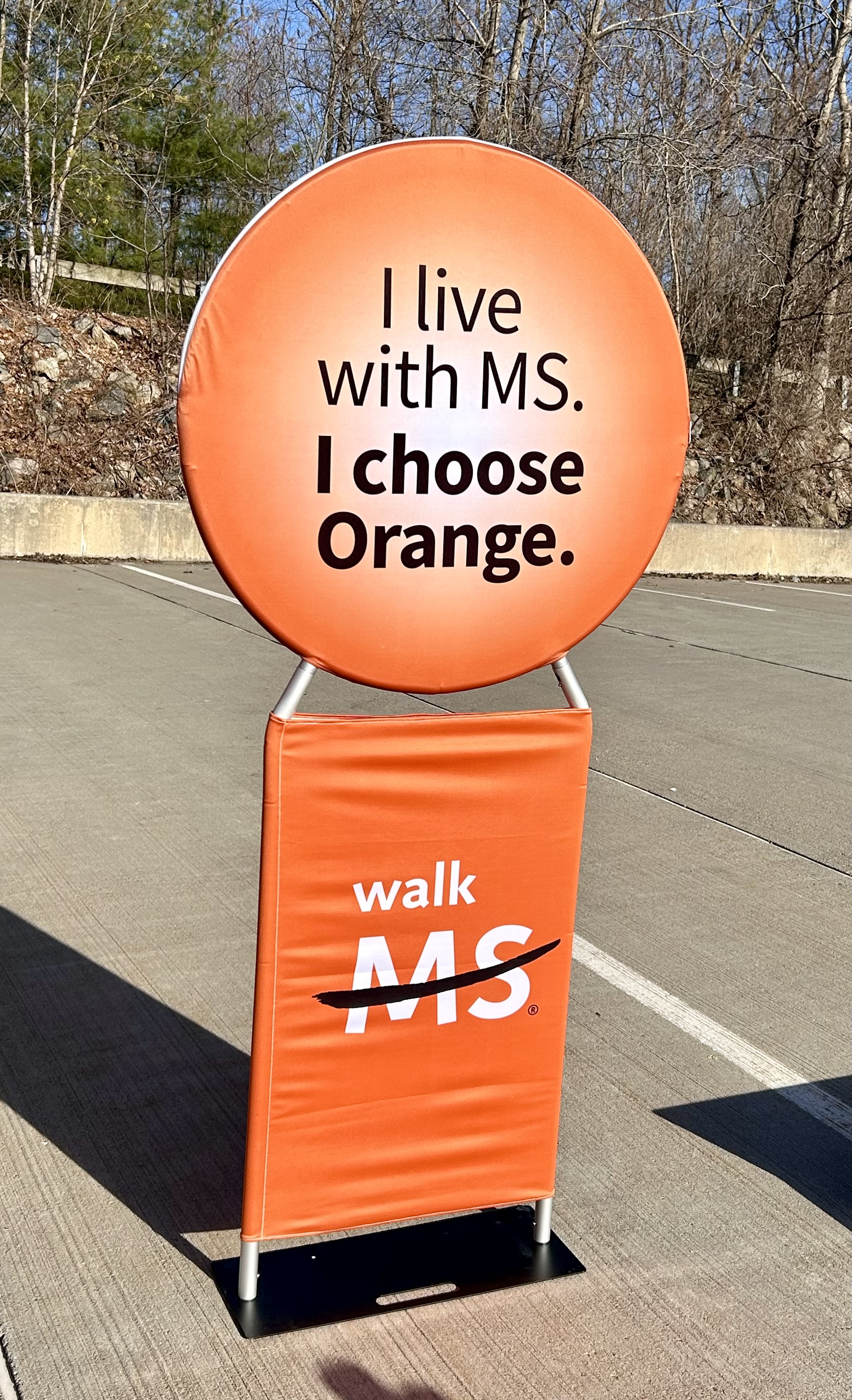
Tanisha Stevens, her husband, her two young daughters, her sister, and her best friend took to the stage as we celebrated her strength, her perseverance, and her loving circles of support. Circles were the big theme this year, hence pictures of people holding circles on plastic sticks: Orange for those with MS, green for those who love someone with MS, and yellow for those who work to support the cause.

Participants — some of whom dressed in very colorful, creative attire including orange tutus — said they felt a sense of camaraderie and really liked the message that no one is in this alone.

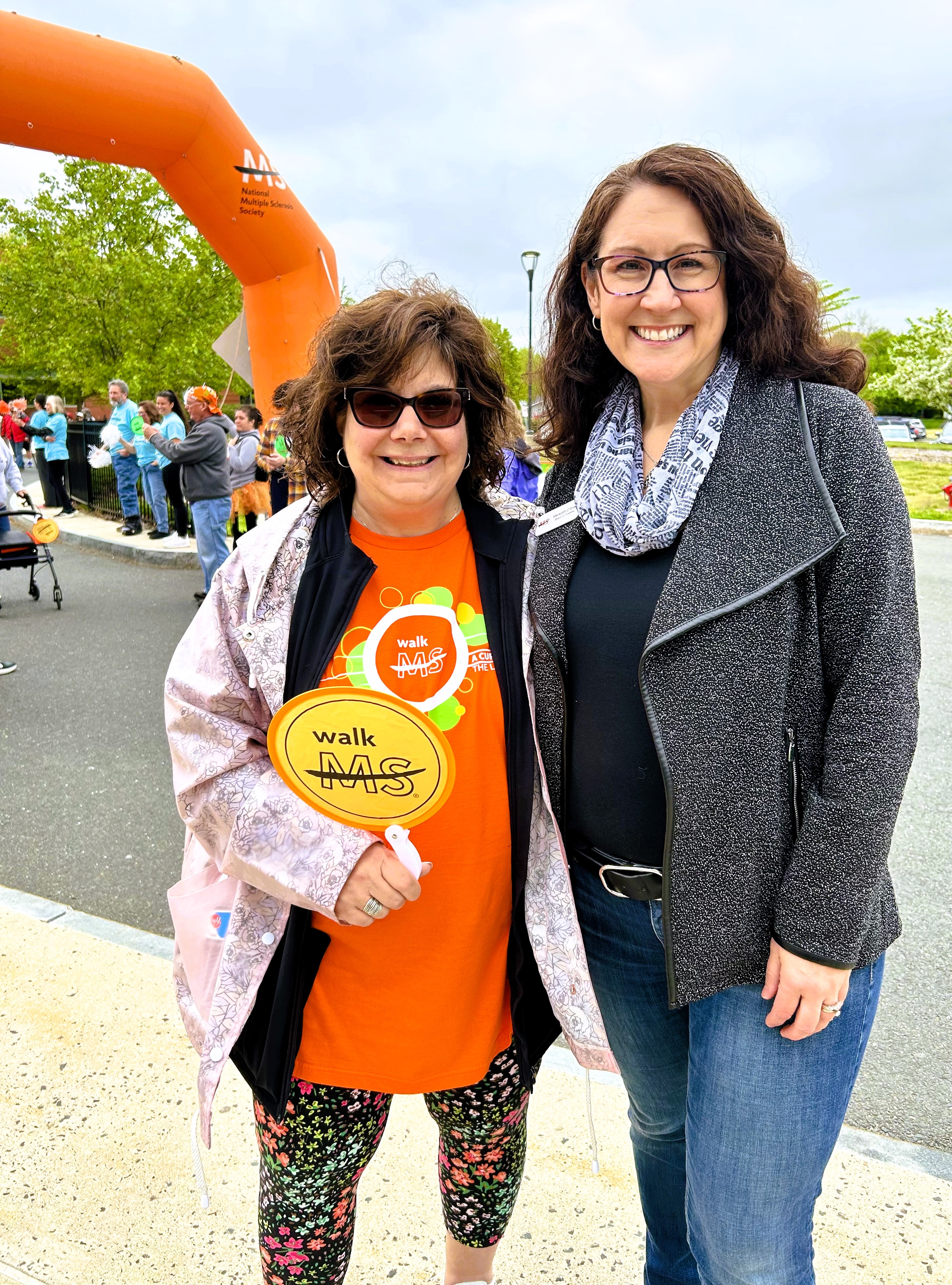
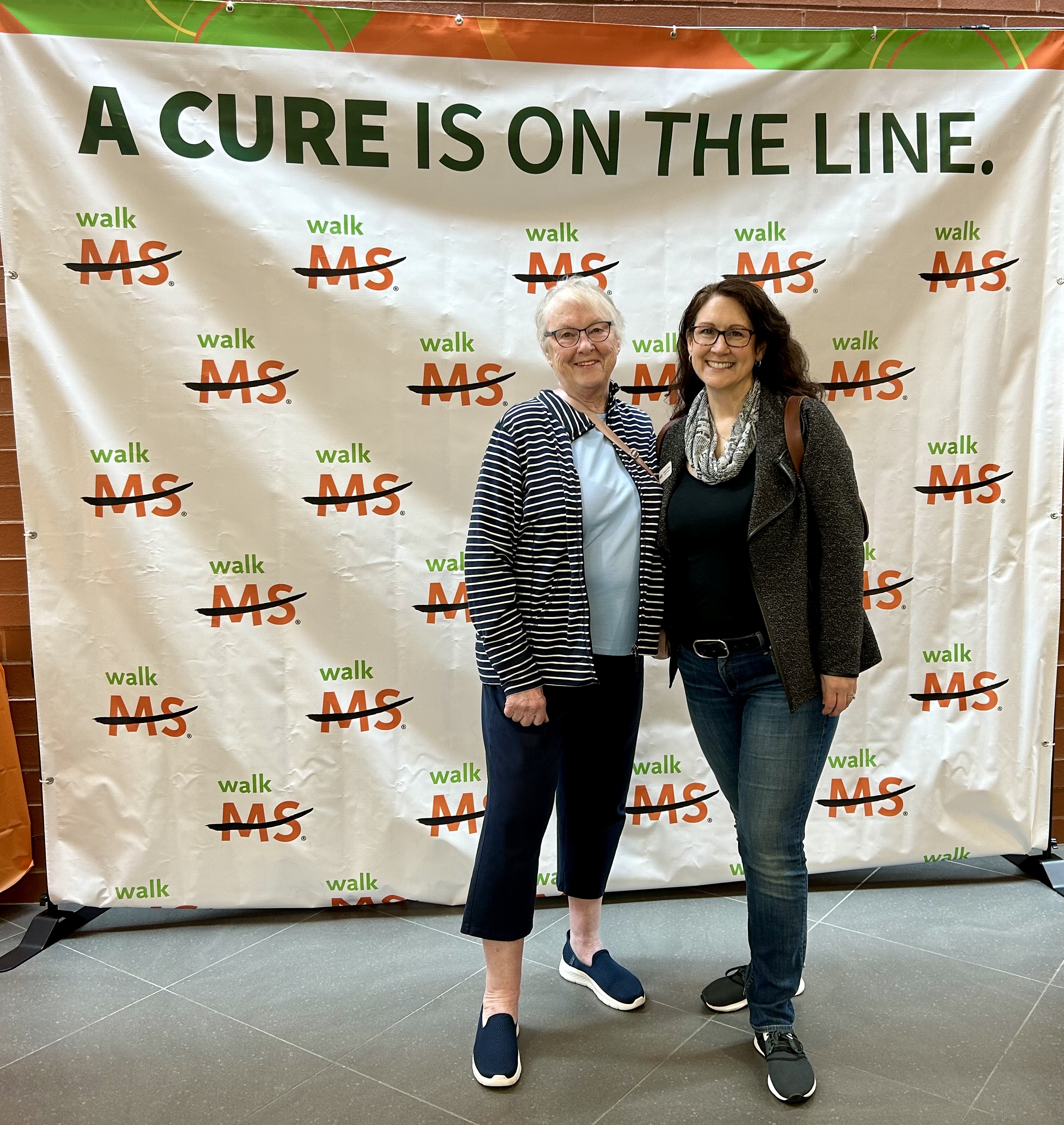
A week later, under mildly threatening skies, I hosted the Walk MS: Longmeadow event at Longmeadow High School in western Massachusetts. As someone who grew up in The 4-1-3 (the area code), I was so pleased to run into people who not only knew colleagues of mine, but also folks who knew my mom, Judy O’Brien, when she was the manager of two stores in Northampton, Mass. and appeared in regular “Wine Mother” segments on a local radio station.

I even met the effervescent, take-no-BS Judy Potter (second down on the right in the collage above) who pulled from her purse the op/ed I wrote which she’d ripped out of the paper that morning. After reading the piece — where I compared Taylor Swift’s “I Can Do It With a Broken Heart” to pretending all is well when you have MS — she said she, someone who’s had MS for decades, had to meet me. Turns out, Judy’s friends with the first editor I worked with at The Republican, Cynthia Simison, who later went on to run the whole operation, becoming the paper’s first woman to hold the post.

While the Longmeadow crowd was smaller than Worcester’s, it felt supportive and enthusiastic nonetheless, something I experienced acutely when an adorable, beefy bulldog practically knocked me over with excitement as I pet him just a few feet beyond the finish line.

umass journalism hosts memoirists

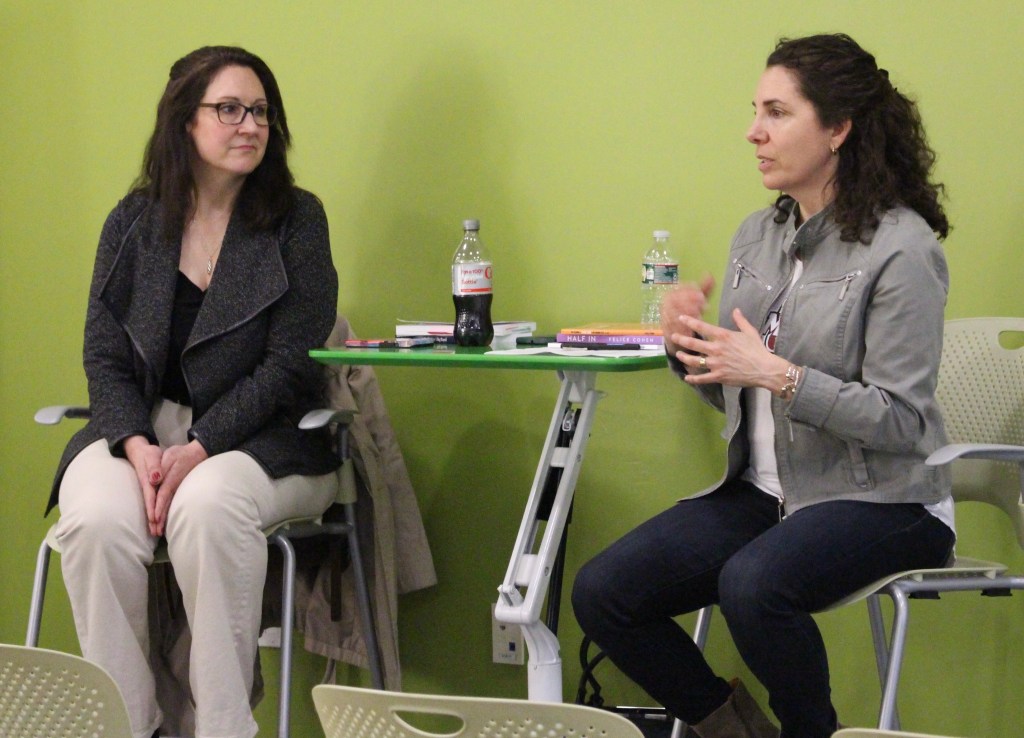
The UMass Journalism Department graciously invited my former UMass/Massachusetts Daily Collegian pal, the award-winning writer Felice Cohen, and me to talk about our experiences writing memoir.

In late April, Felice told attendees that her family read early drafts of her UMass-based memoir, Half In which reveals her 1990s love affair with a much older woman — and said they were supportive of her relating the truth of her experience. She said she heavily relied on the journals she kept during that time to refresh her memory about specific events and conversations, which, in the book, are very detailed. Felice is currently working on what she called a “reverse memoir” using letters she’s received throughout her life.

I, meanwhile, totally put my husband Scott on the spot and asked him what he thought about being portrayed and quoted in my memoir, Uncomfortably Numb, which traces the first several years of my life with multiple sclerosis. His reply? He trusts me (!) to tell my “truth” since I’ve been writing about my life –and, consequently, him — ever since we met when we were undergrads.

It was wild to look around the state-of-the-art Journalism Hub and to later visit the freakishly clean Collegian offices — which, years ago, moved out of its original location in the windowless Campus Center basement. Gone were the days of that smelly, lumpy sofa in the Journalism Department and of messy student newspaper offices with stacks of papers and all manner of wires snaking up the walls and across floors like out-of-control ivy.

Another major difference on the Amherst campus? The dining hall. Not necessarily the halls themselves, but the food within them which is now top notch, a far cry from when the chicken cutlet sandwiches were referred to as “chicken pucks” and the highlight of the week was when fried French toast sticks were on the menu. It’s no wonder why, when I asked my younger son who graduated last year, where we should go out to eat and he said, “The dining hall.”

what did YOU read in 2021?

I consume news in the form of two daily, hard copy newspapers (I know, I’m ancient), the Boston Globe and the New York Times. I also read online subscriptions of the Washington Post and the Wall Street Journal, as well as devour magazines, the New Yorker and New York Magazine (yes, in hard copy), and the online version of The Atlantic.

When I’m not busy reading all of that journalistic and literary goodness (I just added the literary magazine Creative Nonfiction to my subscription list), I’m reading books. Funny books. Serious books. Fiction. Nonfiction. New England-centric. Politically-oriented. My tastes run wide.

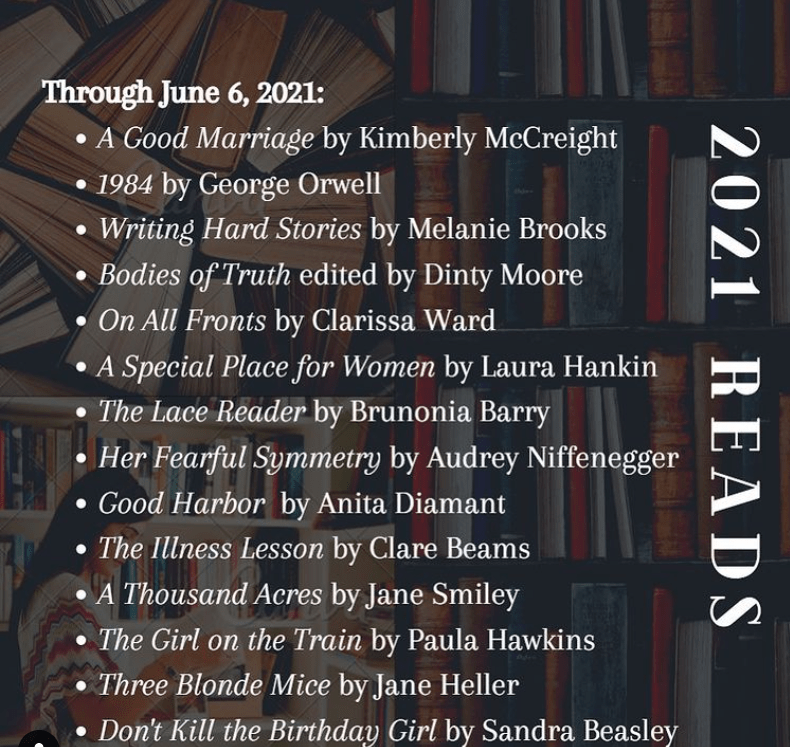
Halfway through the year I published a list on Instagram of the books I’d read starting in January 2021 through early June 2021:

Then, as 2021 drew to an ignominious close with lines for COVID-19 tests wrapping city blocks, I shared the second half of my 2021 reading list:

What did YOU read in 2021? Give the authors a shout-out. They’d appreciate some social media love.

washington post review of books about hunt for covid-19 vaccines

Washington Post image

I was thrilled to have my first book review published in the Washington Post this month. I was asked to read two nonfiction books about the development of the COVID-19 vaccines: Brendan Borrell’s The First Shots and Gregory Zuckerman’s A Shot to Save the World.

The review began this way:

The rapid development and rollout of coronavirus vaccines is one of the biggest news stories in recent memory. As the novel and highly communicable virus began spreading at the end of 2019, the hunt for a vaccine began in early 2020, relying heavily upon a foundation of knowledge created by little-known scientists and researchers. By the time vaccines were being injected into arms at the end of 2020, the United States had lost hundreds of thousands of people to covid-19.

A story this expansive and consequential could surely fill many books. (Think of how many have been written about the 1918 influenza pandemic.) So it really isn’t surprising that two journalists have tackled the same big story in separate new books — with similar titles and stark covers featuring syringes. The books offer dueling tales of how coronavirus vaccines were developed in what seemed like record time. While they cover some of the same territory and quote some of the same people, the books largely shine their respective lights on different narrative slices of the story.

Read the rest of the review here.

Image credit: Washington Post

disability justice project features meredith

I was honored to be invited to serve as a fellow for the Disability Justice Project. As part of my work with the group, I’ll serve as a mentor to a journalist as she works on journalistic projects.

Here’s how the group defines itself:

The Disability Justice Project (DJP) is a strategic partnership between the Disability Rights Fund, an international NGO funding grassroots organizations of persons with disabilities (OPDs) in the Global South, and journalism educator and human rights filmmaker Jody Santos and other nationally recognized media makers from Northeastern University’s School of Journalism in Boston, Massachusetts. Based on a fellowship model, newer professionals with lived experience of disability from the Global South are paired with mentors/professional journalists in the U.S. In an exchange of ideas and experiences, the fellows learn about digital storytelling from some of the best in the industry, while the mentors learn about the global disability justice movement from frontline activists – with the goal of incorporating that new understanding into their reporting for publications like The New York Times and The Guardian or for broadcasters like PBS and ABC.

The group recently ran a feature story about me as I’m writer and journalism faculty member who has a disability (multiple sclerosis). The article entitled, “Meet DJP Mentor Meredith O’Brien,” began:

Disability Justice Project mentor Meredith O’Brien has always loved reading and writing. “As a kid, I was often reading and trying my hand at writing little stories,” she says. “I’d find notebooks around the house and just start writing stories in them.”

catch me talking writing & childhood reporting aspirations on ‘the downtown writers jam’ podcast

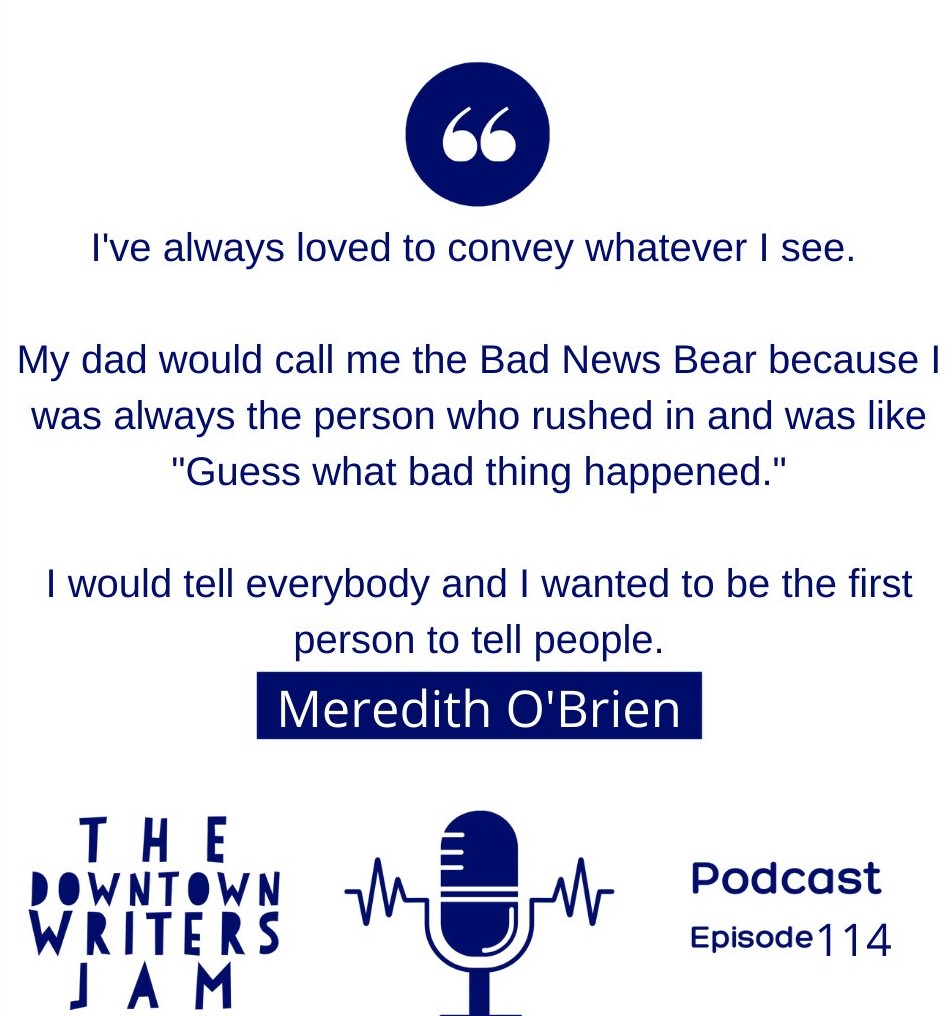
I had a blast chatting with Brad King on his Downtown Writers Jam podcast about writing and journalism, my medical memoir, and my childhood days of pretending to be a reporter when I’d read newspaper (for which I’d eventually become a reporter) out loud while recording myself with my mother’s old, gray tape recorder back when I lived in western Massachusetts.

Please take a listen. I’d love to hear what you think!