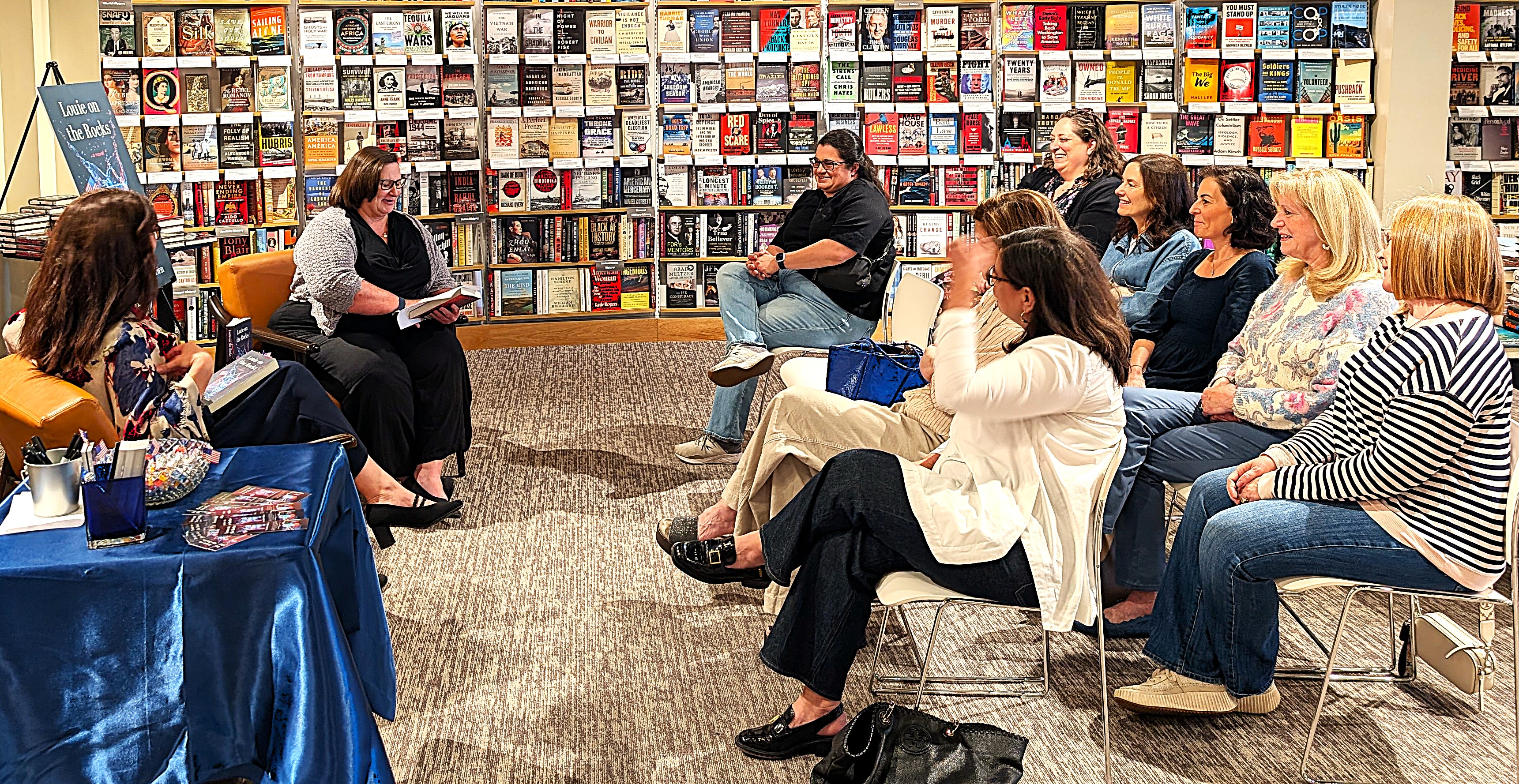
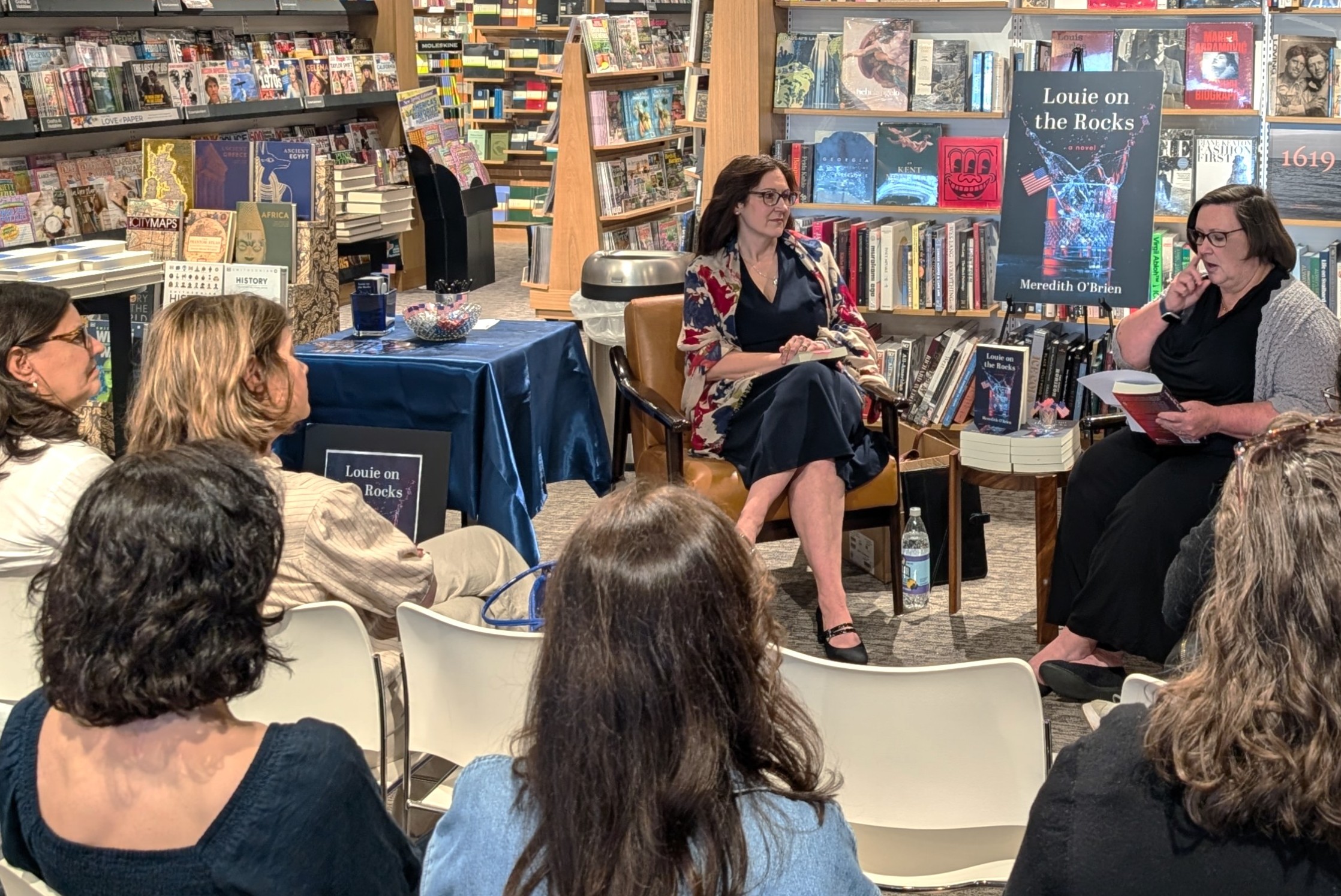
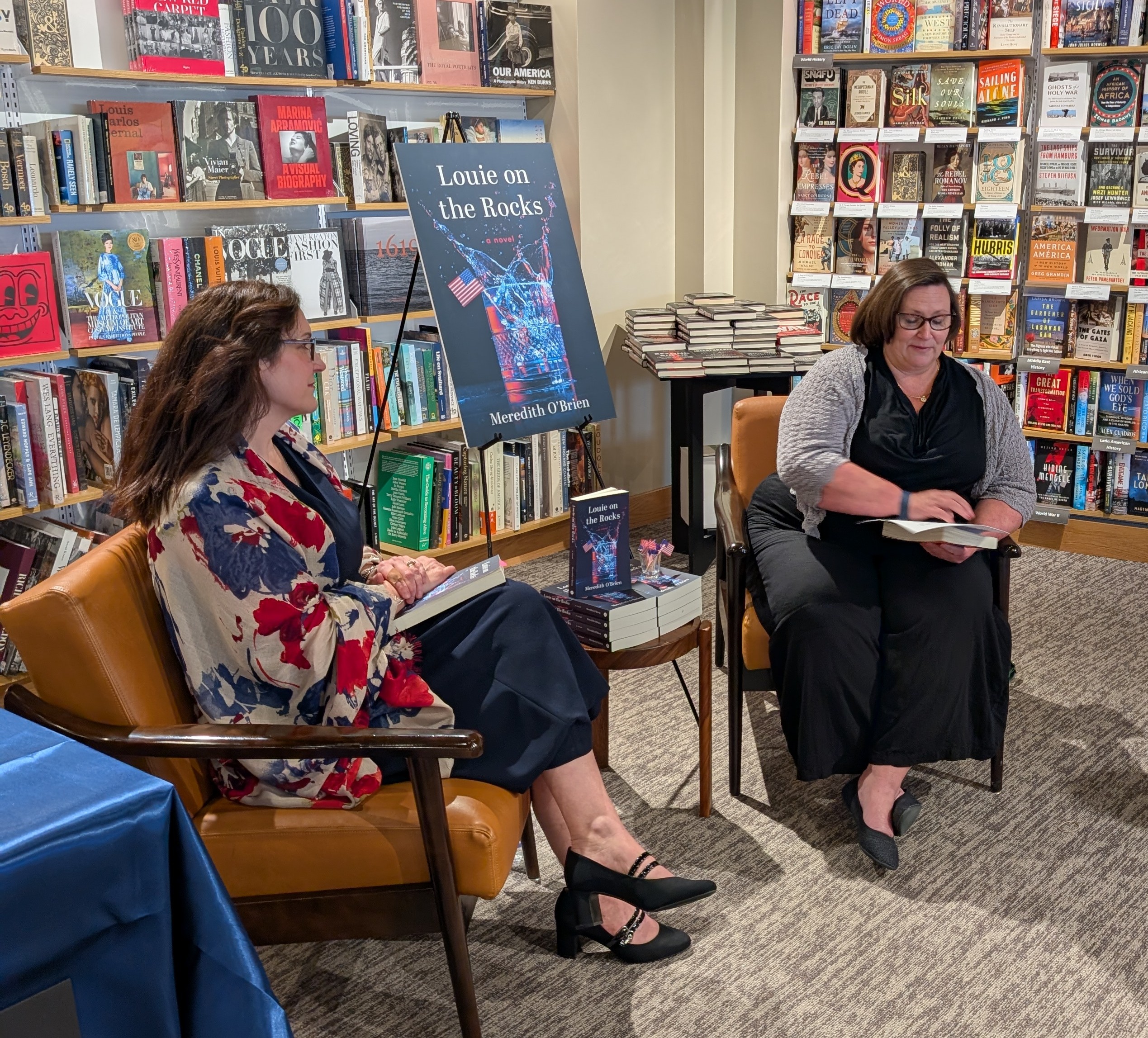
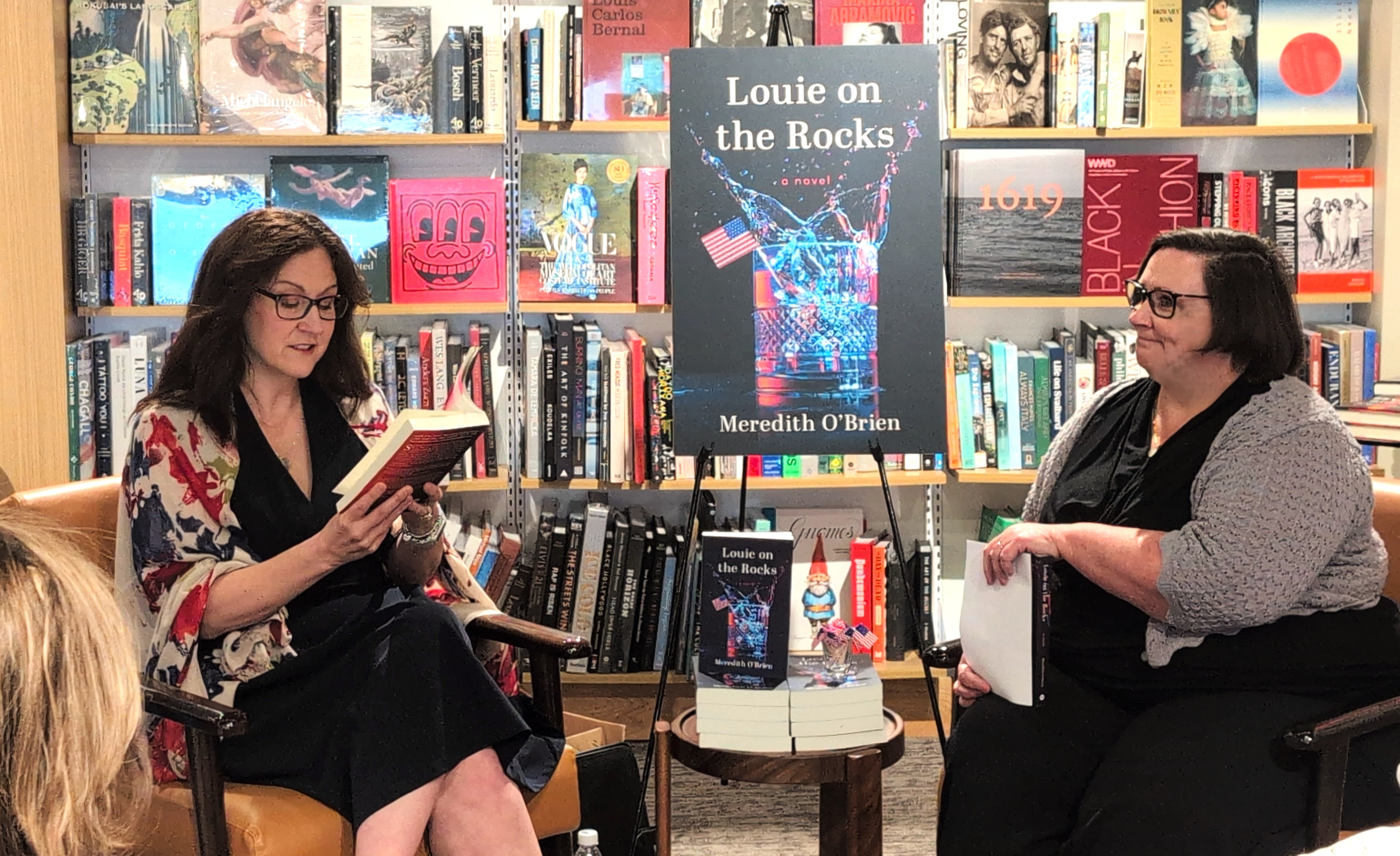
My UMass-Amherst roomie and bestie, Gayle Long Carvalho, showed us her English teacher side by asking insightful and probing questions about Louie’s many themes ranging from generational divisions and understanding the mindset of the lead character as a proxy for MAGA voters, to being the adult child of a parent who isn’t acting in his own best interest and what happens when one spouse in a long marriage dies and leaves behind someone who doesn’t know how to pay the bills.
Gayle was, in two words: rock star.
The lovely crowd boasted friends from Southborough, UMass, and even an MFA student of mine from the Bay Path University MFA creative nonfiction program who I met in the flesh for the very first time. Thanks to all who took the time out of your day to chat with us.
Lots of book events coming up to promote Louie on the Rocks.
Incredible writers — with connections to western Massachusetts, to UMass Amherst, and to Bay Path University’s MFA program in creative nonfiction — have graciously agreed to appear with me. I’m very appreciative of their time.
Please join me in celebrating the launch of my latest book, Louie on the Rocks, at Tatnuck Bookseller in Westborough, Mass. on Saturday, Feb. 15 at 4 p.m.
I’m honored that Worcester writer Kevin Koczwara — a former UMass-Amherst journalism student of mine — will be there to lead a writerly conversation with me about the book and its many themes, ranging from how political polarization affects families to how adult children should deal with struggling older parents.
After the conversation, we’ll do a Q&A, I’ll read a bit from the book, and then sign copies.
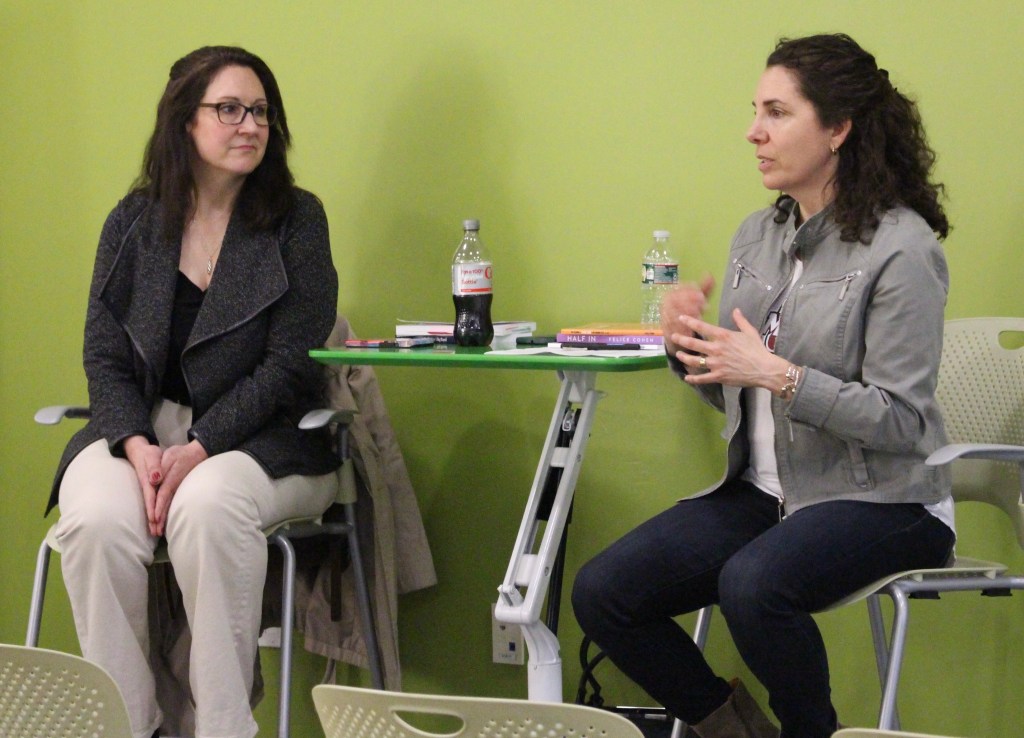
The UMass Journalism Department graciously invited my former UMass/Massachusetts Daily Collegian pal, the award-winning writer Felice Cohen, and me to talk about our experiences writing memoir.
In late April, Felice told attendees that her family read early drafts of her UMass-based memoir, Half In — which reveals her 1990s love affair with a much older woman — and said they were supportive of her relating the truth of her experience. She said she heavily relied on the journals she kept during that time to refresh her memory about specific events and conversations, which, in the book, are very detailed. Felice is currently working on what she called a “reverse memoir” using letters she’s received throughout her life.
I, meanwhile, totally put my husband Scott on the spot and asked him what he thought about being portrayed and quoted in my memoir, Uncomfortably Numb, which traces the first several years of my life with multiple sclerosis. His reply? He trusts me (!) to tell my “truth” since I’ve been writing about my life –and, consequently, him — ever since we met when we were undergrads.
It was wild to look around the state-of-the-art Journalism Hub and to later visit the freakishly clean Collegianoffices — which, years ago, moved out of its original location in the windowless Campus Center basement. Gone were the days of that smelly, lumpy sofa in the Journalism Department and of messy student newspaper offices with stacks of papers and all manner of wires snaking up the walls and across floors like out-of-control ivy.
Another major difference on the Amherst campus? The dining hall. Not necessarily the halls themselves, but the food within them which is now top notch, a far cry from when the chicken cutlet sandwiches were referred to as “chicken pucks” and the highlight of the week was when fried French toast sticks were on the menu. It’s no wonder why, when I asked my younger son who graduated last year, where we should go out to eat and he said, “The dining hall.”
Looking forward to heading back to Amherst with my former college newspaper colleague, Felice Cohen — Collegian alums forever! — to speak with journalism students about journalism, writing, and memoir.
Participants: My then-24-year-old grad student son, my then-21-year-old undergrad son, my spouse, and me (if you can call me a participant).
Subject: Whether a bicycle kick by a Southampton football club player to the head of Chelsea’s football club’s captain warranted a red or yellow card.
For the entirety of our lunch before we headed to campus to see the University of Massachusetts’ men’s hockey game, I could not work my way into the conversation, not during drinks, not during appetizers, not during the main meal, not even during dessert. I couldn’t get the three male members of my family to change the subject to something in which I was conversant, like U.S. politics or the spy balloon that’d been flying over the U.S. or pop culture. Since I couldn’t take part in their animated debate because I had nothing to contribute, I pulled out my phone and began taking notes. Some of the gems they uttered:
What kind of crack are you on?
You’re asking the wrong questions!
You can usually, visually gauge intent!
Just because it’s subjective, doesn’t mean it’s crap.
That’s one of your dumbest takes ever.
The old fashioned I rapidly drained while chronicling their conversation didn’t chill me out nearly enough to cope with, what I described as, “this all-encompassing conversation where all the oxygen goes to British, fucking, soccer.”
By the end of the meal I reached a decision: In order to engage with them, I need to join them. I need to become the last member of my family of five to select a Premier League team and rabidly root for it, because what is British soccer without the rabidness of its fans? My daughter, like her twin brother, is a Liverpool fan. My younger son is a Chelsea fan. My husband tries (rather unsuccessfully) to be the human equivalent of Switzerland, someone who claims to be fans of both teams, but his poker face isn’t as good as he thinks it is.
Personally, I never cared much about soccer – hereafter known called football – aside from watching the U.S. Women’s National Team in World Cup or Olympic matches. A lifelong Boston Red Sox fan who weathered many losing years (1986 … just … no) before the gloriously historic 2004 season which snapped an 86-year losing streak, I’ve also enthusiastically followed my alma mater’s teams (specifically University of Massachusetts hoops and hockey). A fair-weather Celtics fan, I don’t really follow the Boston Bruins or the New England Patriots, although if friends and family gather to watch a big game, I’ll watch with them.
But European football … I’ve never really understood why my family is so enthralled with it and why my late-sleeping sons willingly rise early ON WEEKENDS to watch matches. However, following that aggravating lunch at Johnny’s Tavern in February, I decided I need to figure out why.
I announced to my football-mad relatives that I’d follow the U.K. Premier League when it starts its season in mid-August. I then asked for input on which team I should follow – I didn’t want to choose between my kids’ favorites – adding that I was looking for a club with history, heart, authentic fan passion, and a bit of an underdog vibe. I wanted to ally with folks similar to loyal Red Sox fans. For example, if I hadn’t been born a Red Sox fan, I’d likely follow the Chicago Cubs because I admire their grit and undying loyalty to their club even after enduring 108 long years before they won the World Series in 2016.
Casey, the Chelsea fan, suggested I root for Aston Villa, a 149-year-old football team from Birmingham because he said the club represents the qualities I named: history, passion, and an upward trajectory in the league.
Jonah, my Liverpool-loving son, argued for Newcastle United because he said they’re moving up in the Premier League.
Abbey, my Liverpool-loving daughter, and Anthony, her Manchester United-loving boyfriend, argued for Brighton because they said Brighton is “kind of an up-and-coming team” and “they’re decently placed in the league and unlikely to be relegated … plus, nobody really hates them that much.”
Although they did offer suggestions, Abbey and Jonah made me rethink my approach of selecting a Premier League team out of thin air in order to try to understand the undeniable gravitational pull of British football fandom.
Why, they asked, didn’t I just root for Liverpool, which is owned the Fenway Sports Group, named after Fenway Park, the home of the Boston Red Sox? Liverpool’s connection to the Sox is, afterall, how they became Reds fans in the first place. I didn’t have a good response other than to repeat the mantra that I was hesitant to pick favorites between my children.
I did some research and had a lot of conversations about the Premier League. What I ultimately realized is that I couldn’t artificially muster enthusiasm for a club which, on paper, might seem like as if it meets my criteria. I wasn’t feeling it for any of the teams they suggested, and if there’s one thing I’ve learned from watching my family go football crazy, it’s that emotional connection is paramount. I couldn’t deny the pull of the name “Fenway,” in spite of the current, seriously lackluster Boston Red Sox season. After thinking about all these factors, as well as watching videos of Liverpool fans singing — as if they are one, thoroughly off-key body — the club’s unofficial theme song, “You’ll Never Walk Alone,” I couldn’t help but sense some “Sweet Caroline” kindred-spirit magic.
Starting on the morning of Sunday, August 13, when Liverpool faces off against Chelsea at 11:30 a.m. Boston time, I’ll be rooting for the Reds. Part of me will feel as though I’ve chosen Abbey and Jonah over Casey, however, I hope Casey will be pacified by my promise to root for the Blues whenever they’re playing any other club other than Liverpool (which Jonah says is indicative of the fact that I won’t be a “true” Liverpool fan … let the shit-talking begin).
My football learning curve will be steep. I’ll likely mess up the lingo and offer myriad bone-headed takes, but that’s what happens when you start something new. Just know that I’m drawn to the passion that formed an infuriatingly impermeable wall of verbiage at that lunch table in late winter, and I want to be part of the conversation.








 Meredith OBrien