It’s been a crazy couple of weeks in my world. There’ve been three Liverpool games since the last time I blogged. And they’ve won them all. Beating the Wolves in a come-from-behind win, 3-1. Beating LASK in Europa Cup group match, 3-1. Beating West Ham, in a come-from-behind win, 3-1. Hmm, sensing a trend?
Keeping up with all of this football has been fairly challenging when one is trying to do something called life. I’m teaching, three, college-level courses (all writing classes) which involve a tremendous amount of input and a lot of class prep. Throw in the fact that I’ve got several ongoing writing projects — including organizing my research for a new book and editing my second fiction manuscript — as well as a Rosh Hashanah celebration with the extended family, and attending in-person Boston Red Sox games (my favorite team), and, I don’t know, inconsequential things like sleeping and eating … and things have been a touch chaotic. Shoehorning Liverpool’s Prem games, plus games for other competitions like the Europa Cup, into my daily life, was much simpler before the fall semester began.
To watch the last two Liverpool games required serious multitasking on my part, something I have to imagine many American fans need to accomplish in order to follow football matches taking place on another continent, during hours when Americans would typically be working. Or sleeping.
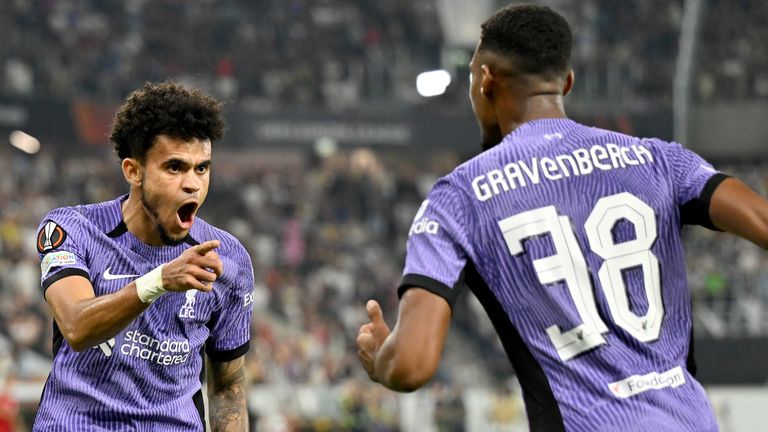
For example, when Liverpool — resplendent in their lavender kits (above) — took on LASK (which stands for Linzer Athletik-Sport-Klub, an Austrian professional football club) in group play for the regional football tournament, the Europa Cup, I streamed it, split-screen, on my laptop. On the right half of the screen was a tiny box streaming the action, and on the other, a manuscript I was editing and into which I had to try not to accidentally input “Nunez,” “Europa,” or “Diaz” while I listened to the announcers. I stopped editing and pulled the game onto the full screen when the Reds finally came alive in the 56th minute after Darwin Nunez scored a penalty kick, followed by Luis Diaz’s 63rd-minute tap-in. “Liverpool are alive and Liverpool are in the lead!” a commentator shouted. In the 88th minute, the always-reliable Mo Salah nutmegged (kicked the ball through an opposing player’s legs) a LASK player and scored in what a commentator said has become Liverpool’s “usual way:” a come-from-behind win.
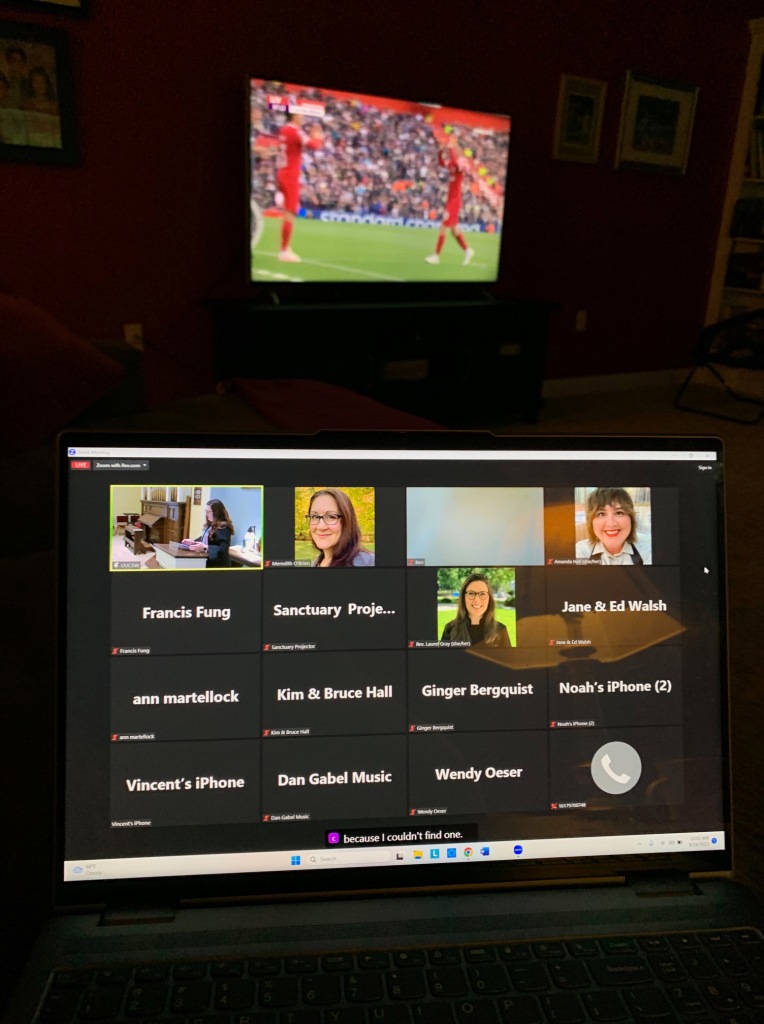
During the latest Liverpool game against West Ham United at home in Anfield, watching this 9 a.m. kickoff meant I had to juggle some things. My initial plan was to watch the first half at my house, drive to church, deposit myself in a back pew, and silently stream the second half from my phone. However, our Peacock account was maxed out on viewers so I wouldn’t be able to stream it. I had a choice to make: Church or Liverpool? Luckily, I could choose both because the Massachusetts church streams its services live. I watched the Liverpool game on the TV and church on my laptop. (See below) I texted Rev. Laurel — about whom I’m working on a book about being a Millennial minister — to explain my scheduling dilemma and she thought it was funny. I spent the second half petrified that I’d accidentally turn on my mic and have my cheers or my shouts of, “Shit!” ring through the church sanctuary speakers.
As has become rote thus far in Liverpool’s season, the club was cold at the beginning of the game, playing like they needed serious infusions of coffee (or tea, as they were playing in the land of tea). But the lackluster playing dissipated by the 16th minute when Salah easily scored on a PK. West Ham tied it by halftime, only to have Nunez score in impressive fashion in the 60th minute. Afterward, Nunez showily kissed his arms and wildly gestured toward the appreciative home crowd. I was even more impressed by the Diogo Jota goal in the 85th minute off of a very odd headed pass from Virgil van Dijk, who had just returned from a multi-game, red-card banishment.
Simultanously, my husband Scott was sitting across from me in the family room streaming the Chelsea game on his phone and my resident Chelsea fan son was in his room watching his preferred team, the Blues, which lost. And whenever Chelsea loses, a grumpy pall is cast over the house. No one is to speak about the game for at least 24 hours.

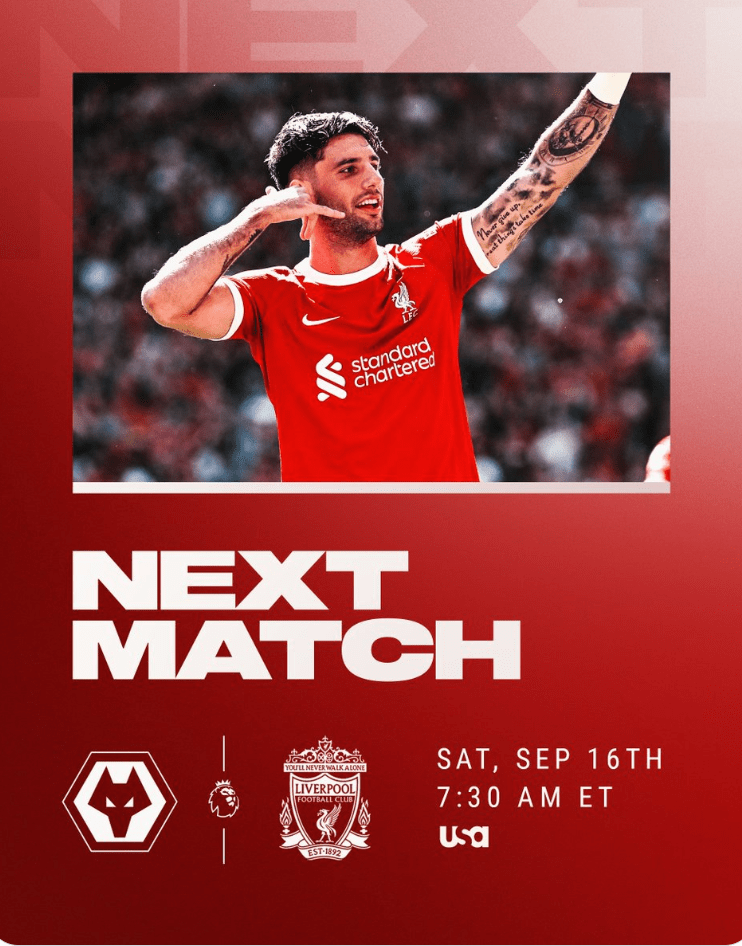
The only recent, Liverpool game to which I was able to devote my full attention was the Saturday, Sept. 16 match against the Wolves. That weekend, my house was filled with my three adult children and my daughter’s boyfriend. Football fans, all. We all got up early to watch the Liverpool game before I made dishes to bring to a family Rosh Hashanah dinner in the afternoon. (I made mini-potato kugels in cupcake tins, a salad whose components hailed from a local farm, and brought bottles of wine. My daughter baked an apple pie.) Outside, powerful winds from the dregs of Hurricane Lee which swept up the US East Coast, rattled the family room windows as rain poured intermittently. I gulped down several cups of coffee to wake myself up, seeing that the game kicked off at 7:30 a.m. Boston time.
The match began with the Reds playing … poorly. The Wolves were able to slice through their lackluster defense like a hot knife through butter. It was no surprise when the Wolves struck first, scoring the game’s first goal through the legs of Andy Robertson in the seventh minute. My ardent Liverpool fan son Jonah was edgy, 10 minutes in, “They’re on the ropes already!” For the bulk of the game, the Wolves’s lead felt more substantial than 1-nil because Liverpool was playing so badly.
Then … Salah.
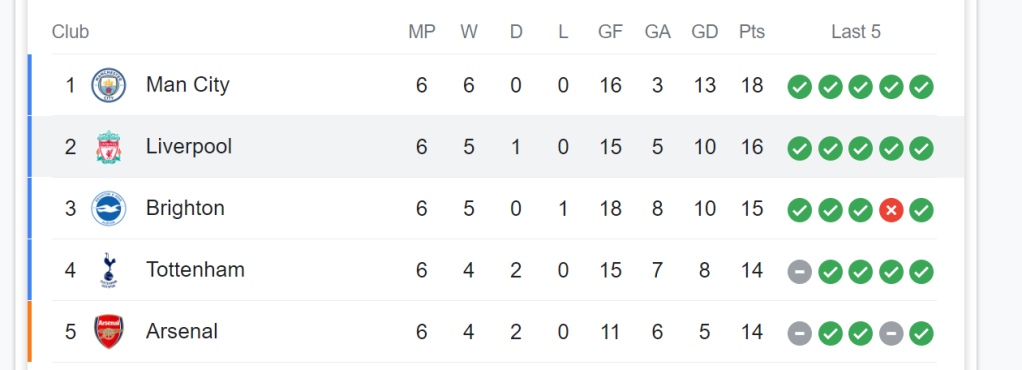
In the 55th minute, Salah sent Cody Gakpo the ball who converted it into the first Reds goal. Thirty minutes later, Robertson’s goal (pic above) caused Jonah to raise his right fist in triumph, “He NEVER scores!” The room’s dour mood shifted like quicksilver as a Liverpool W seemed possible. A Liverpool win was cemented by an unlucky own-goal by the Wolves’ Hugo Bueno (he accidentally tipped the ball into his team’s net) making it 3-1 Liverpool.
Next up for the Reds in the Prem: A match at Tottenham (my nephew’s favorite team) on Saturday, Sept. 30 at 12:30 ET.
Random bits:
- I’ve now learned that it’s routine behavior for defensive players who are lining up to block a direct kick on goal, to not only protect their crotches, but to also jump vertically. Additionally, one player lies facing toward the goal — away from the opposing team’s kicker — should the kicker try to send the ball rolling on the pitch beneath the jumping defensemen. (This nugget of info was gleaned after I asked my kids, “Why is that dude lying on the ground?”)
- Several weeks into the Premier League season, I haven’t quite memorized the Liverpool players’ names and often struggle to identify them on the pitch, especially if I’m not wearing my glasses. I’m working on it.
- XG. Who knew that XG means “expected goals,” meaning, how many goals each team and/or player is expected to deliver in any given game? Everyone in my family except for me, the football newbie. I likened XG to a Major League Baseball pitcher’s ERA or a hitter’s batting average. However any time I liken football to baseball in my attempts to understand it, I get eye rolls. Nonetheless, I persist!
Image credits: Sky Sports, ESPN and Google.


 Meredith OBrien