adventures in british football: catching up on the month of december

So … yeah … I’ve been a tad incommunicado here on this blog where I said I’d be chronicling my nascent Liverpool fandom. I’ll share with you some of the reasons why because I like to hold myself accountable:

I spent December wrapping up the fall semester and grading dozens of submissions from students in my undergraduate journalism class and two master’s of fine arts classes. When I completed that task, I revised three syllabi and three sets of online course modules for the spring 2024 semesters for three courses.

Additionally, there was the whole Christmas holiday prep — buying presents for the family and spending hours wrapping, planning the menus for two holiday dinners, cooking/baking, cleaning the house, and squeezing in a mid-December trip to visit my daughter Abbey and her boyfriend Anthony in their Bronx apartment.

In addition to helping my senior citizen father with his weekly medicine, paying his bills, and taking him to his medical appointments, I had meetings for the National Multiple Sclerosis Society (where I’m a member of the local chapter’s Board of Trustees, as well as an MS Activist, which means I lobby state and federal officials for bills which help those with chronic illnesses). I also did some more research for my work-in-progress about a Massachusetts Millennial minister, and, this is my low-key announcement, started working with a publisher to prep my second novel for a February 2025 publication date.

So … yeah … maybe taking on this British football project was a tad too ambitious. I realized early in December that I just would not have the opportunity to pull together blog posts for each game I watched. And I did watch all but one Liverpool game since I last blogged about the Reds. (I missed the Dec. 6, 2023 game against Sheffield United — which Liverpool won 1-nil — because there were too many people logged onto our streaming account. We’ve remedied the situation by purchasing our Liverpool-fan son Jonah an online streaming subscription for Christmas.) I watched eight games during December and one on New Year’s Day in my Boston area home, in our family’s Cape Cod place, en route to and in church, at Sean’s Bar & Kitchen in New York City, and at an in-law’s house during a holiday event. I took notes while watching most of these contests, but lost the ones I jotted on a Sean’s Bar & Kitchen napkin.

The Reds have compiled an impressive record during the past 10 games, winning seven, tying two, and losing one, the Europa group league game vs USG, which my Chelsea-fan son told me didn’t matter because Liverpool was advancing out of group play anyway, so I’d say they had a good December, in spite of my blogging lapse.

While I’ll post some highlights from my notes below, one question has been haunting me over the over-packed month of December: How can fans possibly keep up with all these games? Do they watch all of these games or some of them?

I, for example, don’t watch every Boston Red Sox game, given that they have 162 of them a season, and I still call myself a fan. I think I’ve been unduly influenced by my Chelsea-fan son who’s of the mind that only real fans watch every football game. (Yes, he’s employed.) I now realize that it’s unlikely that I’ll be able to blog about every game, and that’s okay. I’ll still watch as many as I can, taking notes when I can, and posting as I can.

As a British football newbie, I still find all these concurrent tournaments — EFL, Europa, never mind players leaving to play for their national teams’ continental football tournaments (like Mo Salah leaving Liverpool to participate in the Africa Cup of Nations for much of January) — befuddling. I’m unaccustomed to trying to balance all of the competitions in my mind. I think following just the Premier League would be simpler, but my Chelsea-mad son has strongly implied that would be very “plastic” of me. And, God knows, I don’t wanna be plastic.

Continue reading “adventures in british football: catching up on the month of december”

adventures in british football: so many prem football questions

I’ve got questions. Lots of ‘em. Stupid questions, pointed questions, legit questions. Let’s start with the ones that’ve been really nagging me.

International breaks

Why are there so many breaks in the Premier League’s season? I’d never even heard of such a thing until the end of the last Liverpool game against Aston Villa, when announcers mentioned that the next game would occur AFTER the international break.

The international … what?

I did a round of internet sleuthing and learned that the English Premier League has loads of players who participate in the Euro Cup for their home countries’ teams, as well as for the Asia Cup and the Africa Cup of Nations, according to Metro UK. So the Prem accommodates them — most of them anyway — with breaks. Several of them, as outlined by the Metro:

So this led to my having to read up about the 2024 Euro Cup, for which national teams must endure months of qualifying rounds, similar to the World Cup. There are qualifying matches in September, October, and November before the semi-finals in March 2024 and finals in June and July.

I struggled to find a comparable situation in American professional sports. There are pauses, for example, for the World Cup in American pro soccer, but that’s only every four years, and, I believe their schedule isn’t affected by the World Cup, at least it wasn’t last year. With Major League Baseball, there’s a midseason break for the All-Star game and associated festivities; the World Baseball Classic takes place during MLB’s spring training so there’s no need for a league-wide break. One American professional sports league, the National Hockey League, refused to take a break from play before the 2022 winter Olympic games. The NBA similarly opted to keep the regular schedule going during the rescheduled 2021 summer Olympics, so the concept of multiple “international breaks” proved befuddling to this American fan.

What do the breaks mean for the Liverpool team, my chosen PL club? According to the team website, these players are participating in qualifiers for international teams:

  • Alexis MacAllister — Argentina
  • Alisson Becker — Bolivia
  • Luis Diaz — Colombia
  • Kostas Tsimikas — Greece 
  • Dominik Szoboszlai — Hungary
  • Caoimhin Kelleher — Ireland 
  • Cody Gakpo and VVD — Netherlands 
  • Diogo Jota — Portugal
  • Andy Robertson — Scotland
  • Darwin Nunez — Uruguay

“Trent Alexander-Arnold has withdrawn from England’s squad … due to injury,” according to Liverpool. Mo Salah is slated to play with Egypt in the Africa Cup qualifiers, the Reds’ site said, adding that Wataru Endo will join the Japanese team to play friendlies. But because the bulk of the Africa Cup runs from January through February — during which the Prem will only take a pause from Jan. 14-30 — that means if a player’s national team does well, that player could miss one or two Prem games, according to TalkSport.com. For Salah, the website reported he could miss Liverpool’s matches against Chelsea and Arsenal if Egypt’s national team is still alive in the Africa Cup’s later rounds.

Plural or singular?

Seeing that I’m a word nerd, it’s been bugging me to hear people refer to football teams’ host cities in the plural format. For example, when I discuss the Boston Red Sox, I say, “Boston is miserable this year.” I use a singular verb, “is.” Boston is one city. There is one baseball team represented by the name “Boston” in that sentence. However, when people discuss the Liverpool Football Club, I’ve noticed they say things like, “Liverpool are doing well so far.” The word “are” is generally used when describing the actions of more than one entity. The Liverpool Football Club is a singular organization.

Listening to people say, “Liverpool are winning,” is cramping my brain. It was during one such brain cramp when I wound up in a big argument with Chelsea-fan Casey about this very subject. He pointed out that I refer to the “Red Sox” in the plural form. (“The Red Sox are losing.”) I replied by saying using the word “are” makes sense when most American sports’ teams nicknames are plural, as in, more than one sock, more than one Yankee, more than one Patriot, etc. But when you’re talking about Liverpool or Chelsea, you’re only talking about one team. We went round and round for a while until my head ached and I wound up fleeing the room. When I took to the internet again, I discovered a site that proved football-mad Casey correct:

“In the Premier League, all football teams are singular in form (Arsenal, Manchester Utd, Chelsea),” said the website Premier Skills, “but, in British English, we use a plural form when we are referring to the football team and their actions. For example: ‘Arsenal are on the attack. Chelsea have won again.’”

Okay, Casey, you were right. Again. At least when it comes to how the English refer to their football clubs.

Names on jerseys (okay, they’re called ‘kits’ in the UK, and football cleats are called ‘boots’ but the spikes at the bottom are called ‘studs’ in England, I think … )

I was super confused a few weeks ago after Darwin Nunez came off the bench and scored Liverpool’s only two goals to defeat Newcastle. Why? Because his jersey has the name “Darwin” on the back. So when commentators started going on about “Nunez,” I was thinking, Who’s Nunez? Darwin is the one who scored. (I was similarly thrown when everyone was referring to the goalkeeper, Alisson Becker, as “Alisson,” but at least the back of his jersey says, “A. Becker.”)

Later, I learned that I was thinking like an American sports fan. In the US, players’ surnames are on the backs of their jerseys, not their first names or their nicknames. Red Sox legend David “Big Papi” Ortiz had “Ortiz” on the back of his jersey, not “Big Papi” or “David.”

Research informed me that if the Premier League gives its okay, players can put their first names or nicknames on their shirts. So when you mix in first names, nicknames, and surnames, that can lead to a lot of confusion to those new to the sport.

According to the Daily Mirror, the Prem’s rules about names on jerseys was “relaxed” in 2000. “Shirts should feature the player’s last name or such other name as approved in writing by the Premier League Board,” the Mirror reported. “These can be nicknames adopted from abroad which are more likely to be accepted if featured in other leagues.” 

Well, okay then. Another bizarre rule for this Yank to wrap her head around, along with messed-up verb tenses and more breaks than an American member of Congress. Onto Saturday’s match.

Image credits: Metro UK, Liverpool FC’s website, and Liverpool FC’s Twitter feed.

adventures in british football: weeks three & four … then a break, already?

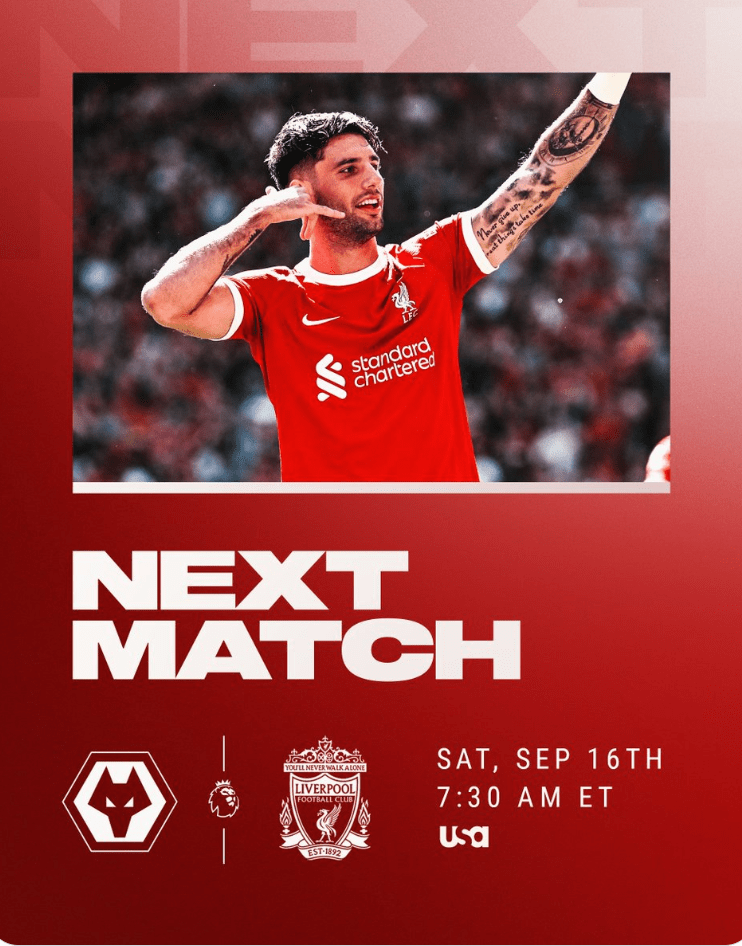
I’m a tad behind on blogging about my adventures following the Prem this season because I was on vacation on Cape Cod and was trying to NOT work during that time, which meant no writing. But I did watch Liverpool rack up two more wins … and now they’re on a break? Already? Only four weeks in? I’ll tackle my being mystified by that fact in a separate post. Meanwhile, below are recaps of weeks three and four in my British football odyssey.

Week Three: Short One Player, Liverpool Comes from Behind to Beat Newcastle, 2-1

My Liverpool-fan son Jonah joined his Chelsea-fan brother Casey, the “neutral” Scott, and Liverpool-fan me minutes before the Reds took on the Magpies at St. James’ Park. (Okay, I know that the name “Red Sox,” especially with its odd spelling, is a stupid team name, but, come on … magpies?)

Anyway … Jonah, who was celebrating his 25th birthday, spent most of this game slamming his fist into the couch and shouting, “No!!” which caused our 12-pound, caffeine-on-legs dog Tedy to bark wildly, widely sharing his nasty breath around the room with each, “woof.” (We can never tell if he barks when we cheer or jeer because he wants to join in or because the sounds upset him.)

The flurry of yellow/red cards didn’t make for an enjoyable first half in my house. As the sea of black-and-white clad Newcastle fans provided nearly constant noise for the first nine minutes of the match, Trent Alexander-Arnold, Liverpool’s right-back, received a yellow card early in the game for tossing the ball out-of-bounds after he believed he was fouled on the back but the shove wasn’t called. (See above.) Seriously? Given the immense physicality (and subsequent bad acting) in typical EPL (English Premier League) games, tossing a ball away, instead of to an official, leads to a yellow card? Yes, according to this season’s new Prem rules, established to curb bad behavior. Officials, according to TalkSport.com, can distribute yellow cards for “time-wasting from the clear and obvious (kicking the ball away), to the more subtle (delaying goal-kicks).” This meant the Alexander-Arnold couldn’t play as aggressively for the remainder of the game lest he receive a second yellow card and serve a one-game suspension.

“Trent’s finished, mate,” Casey said to Jonah, as the two expected Alexander-Arnold to be subbed out. Only he wasn’t subbed out.

By 24:44, the guy who Jonah and Casey thought should’ve been subbed out misplayed a pass and Newcastle’s Anthony Gordon scored. Jonah and “neutral” Scott groaned their displeasure. Three minutes later, Liverpool’s defender Virgil Van Dijk (VVD) received a controversial red card — meaning he leaves the game, the team continues with one fewer player, and he’d be suspended for the next game — which prompted the loudest angry shouting in my house that morning. Tension in our family room was thick and was curdling the coffee in my stomach.

While some Liverpool fans think VVD got his foot on the ball while tackling a Newcastle player, the referee “deemed Van Dijk’s foul on [Alexander Isak] to be a denying an obvious goal-scoring opportunity (DOGSO), leading to the red card,” according to Liverpool.com. A what now? A Dogso? Do dogsos get along with magpies? (I know. Stupid mom humor. I’ll stop now.) The commentators were agog saying this red card “brandished in his face [was] for the first in seven years.”

While Liverpool goaltender Alisson Becker made a dramatic save – even Casey blurted, “Hooollly cow” in serious admiration – the talk in our house at halftime was about whether the rumors about Mo Salah going to the Saudi Pro League for a massive, otherworldly payday were legit. This topic further darkened Jonah’s mood.

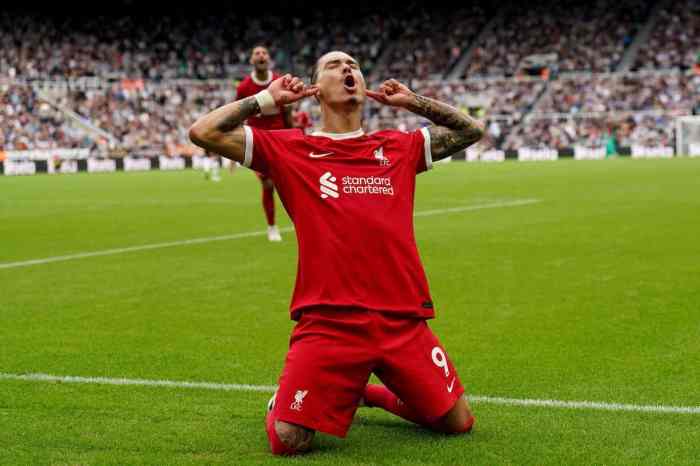
The Reds’ luck changed in the second half and people in my living room became markedly less grumpy. After coming off the bench in the 77th minute, Darwin Nunez (above) outmaneuvered a Newcastle player and scored, yielding the day’s first loud exclamations of the happy variety (accompanied by Tedy’s yappy barking sending its indiscriminate message).

The happiness was short lived as, four minutes later, Nunez received a yellow card because, like Alexander-Arnold, he disposed of the ball (kicked it away) like an angry child instead of just giving it to the ref. Has the dude not been paying attention? They’re down a player already? I thought but didn’t say out loud. However, said dude redeemed himself minutes later with his second goal, lighting up the resident birthday boy’s face watching the game with me. As the whistle blew and Liverpool emerged victorious, the commentators employed lame, Dad-joke puns like, “A Darwin evolution is underway.”

Image credit: This is Anfield.

Continue reading “adventures in british football: weeks three & four … then a break, already?”