I’ve got questions. Lots of ‘em. Stupid questions, pointed questions, legit questions. Let’s start with the ones that’ve been really nagging me.
International breaks
Why are there so many breaks in the Premier League’s season? I’d never even heard of such a thing until the end of the last Liverpool game against Aston Villa, when announcers mentioned that the next game would occur AFTER the international break.
The international … what?
I did a round of internet sleuthing and learned that the English Premier League has loads of players who participate in the Euro Cup for their home countries’ teams, as well as for the Asia Cup and the Africa Cup of Nations, according to Metro UK. So the Prem accommodates them — most of them anyway — with breaks. Several of them, as outlined by the Metro:

So this led to my having to read up about the 2024 Euro Cup, for which national teams must endure months of qualifying rounds, similar to the World Cup. There are qualifying matches in September, October, and November before the semi-finals in March 2024 and finals in June and July.
I struggled to find a comparable situation in American professional sports. There are pauses, for example, for the World Cup in American pro soccer, but that’s only every four years, and, I believe their schedule isn’t affected by the World Cup, at least it wasn’t last year. With Major League Baseball, there’s a midseason break for the All-Star game and associated festivities; the World Baseball Classic takes place during MLB’s spring training so there’s no need for a league-wide break. One American professional sports league, the National Hockey League, refused to take a break from play before the 2022 winter Olympic games. The NBA similarly opted to keep the regular schedule going during the rescheduled 2021 summer Olympics, so the concept of multiple “international breaks” proved befuddling to this American fan.
What do the breaks mean for the Liverpool team, my chosen PL club? According to the team website, these players are participating in qualifiers for international teams:
- Alexis MacAllister — Argentina
- Alisson Becker — Bolivia
- Luis Diaz — Colombia
- Kostas Tsimikas — Greece
- Dominik Szoboszlai — Hungary
- Caoimhin Kelleher — Ireland
- Cody Gakpo and VVD — Netherlands
- Diogo Jota — Portugal
- Andy Robertson — Scotland
- Darwin Nunez — Uruguay
“Trent Alexander-Arnold has withdrawn from England’s squad … due to injury,” according to Liverpool. Mo Salah is slated to play with Egypt in the Africa Cup qualifiers, the Reds’ site said, adding that Wataru Endo will join the Japanese team to play friendlies. But because the bulk of the Africa Cup runs from January through February — during which the Prem will only take a pause from Jan. 14-30 — that means if a player’s national team does well, that player could miss one or two Prem games, according to TalkSport.com. For Salah, the website reported he could miss Liverpool’s matches against Chelsea and Arsenal if Egypt’s national team is still alive in the Africa Cup’s later rounds.
Plural or singular?
Seeing that I’m a word nerd, it’s been bugging me to hear people refer to football teams’ host cities in the plural format. For example, when I discuss the Boston Red Sox, I say, “Boston is miserable this year.” I use a singular verb, “is.” Boston is one city. There is one baseball team represented by the name “Boston” in that sentence. However, when people discuss the Liverpool Football Club, I’ve noticed they say things like, “Liverpool are doing well so far.” The word “are” is generally used when describing the actions of more than one entity. The Liverpool Football Club is a singular organization.
Listening to people say, “Liverpool are winning,” is cramping my brain. It was during one such brain cramp when I wound up in a big argument with Chelsea-fan Casey about this very subject. He pointed out that I refer to the “Red Sox” in the plural form. (“The Red Sox are losing.”) I replied by saying using the word “are” makes sense when most American sports’ teams nicknames are plural, as in, more than one sock, more than one Yankee, more than one Patriot, etc. But when you’re talking about Liverpool or Chelsea, you’re only talking about one team. We went round and round for a while until my head ached and I wound up fleeing the room. When I took to the internet again, I discovered a site that proved football-mad Casey correct:
“In the Premier League, all football teams are singular in form (Arsenal, Manchester Utd, Chelsea),” said the website Premier Skills, “but, in British English, we use a plural form when we are referring to the football team and their actions. For example: ‘Arsenal are on the attack. Chelsea have won again.’”

Okay, Casey, you were right. Again. At least when it comes to how the English refer to their football clubs.
Names on jerseys (okay, they’re called ‘kits’ in the UK, and football cleats are called ‘boots’ but the spikes at the bottom are called ‘studs’ in England, I think … )
I was super confused a few weeks ago after Darwin Nunez came off the bench and scored Liverpool’s only two goals to defeat Newcastle. Why? Because his jersey has the name “Darwin” on the back. So when commentators started going on about “Nunez,” I was thinking, Who’s Nunez? Darwin is the one who scored. (I was similarly thrown when everyone was referring to the goalkeeper, Alisson Becker, as “Alisson,” but at least the back of his jersey says, “A. Becker.”)
Later, I learned that I was thinking like an American sports fan. In the US, players’ surnames are on the backs of their jerseys, not their first names or their nicknames. Red Sox legend David “Big Papi” Ortiz had “Ortiz” on the back of his jersey, not “Big Papi” or “David.”
Research informed me that if the Premier League gives its okay, players can put their first names or nicknames on their shirts. So when you mix in first names, nicknames, and surnames, that can lead to a lot of confusion to those new to the sport.
According to the Daily Mirror, the Prem’s rules about names on jerseys was “relaxed” in 2000. “Shirts should feature the player’s last name or such other name as approved in writing by the Premier League Board,” the Mirror reported. “These can be nicknames adopted from abroad which are more likely to be accepted if featured in other leagues.”
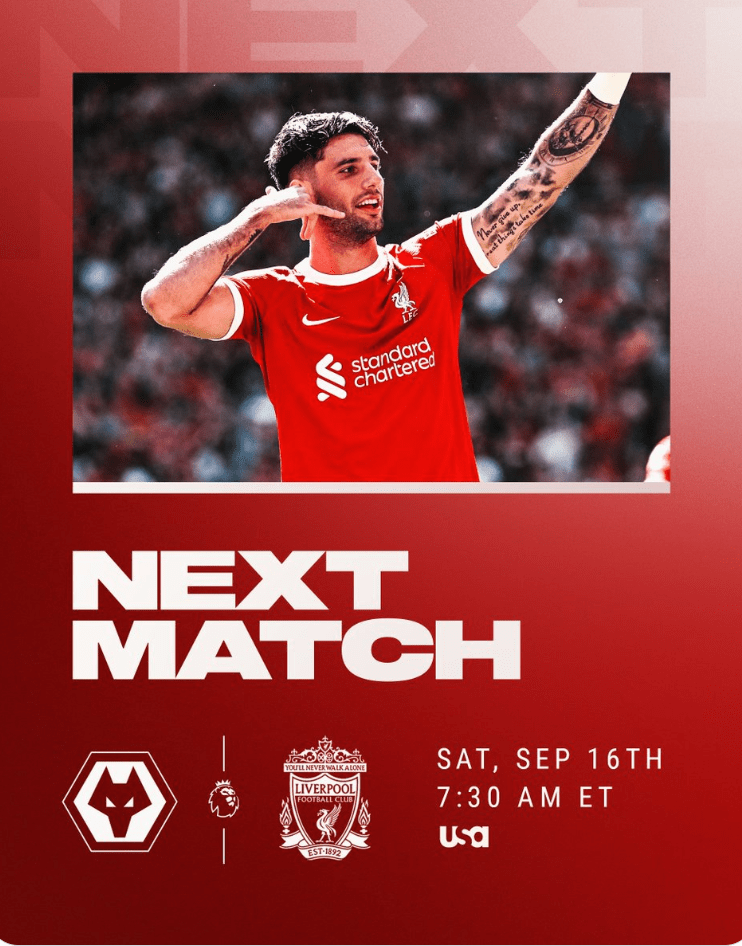
Well, okay then. Another bizarre rule for this Yank to wrap her head around, along with messed-up verb tenses and more breaks than an American member of Congress. Onto Saturday’s match.
Image credits: Metro UK, Liverpool FC’s website, and Liverpool FC’s Twitter feed.


 Meredith OBrien