adventures in british football: so many games … so little time, plus a choice: church or liverpool

It’s been a crazy couple of weeks in my world. There’ve been three Liverpool games since the last time I blogged. And they’ve won them all. Beating the Wolves in a come-from-behind win, 3-1. Beating LASK in Europa Cup group match, 3-1. Beating West Ham, in a come-from-behind win, 3-1. Hmm, sensing a trend?

Keeping up with all of this football has been fairly challenging when one is trying to do something called life. I’m teaching, three, college-level courses (all writing classes) which involve a tremendous amount of input and a lot of class prep. Throw in the fact that I’ve got several ongoing writing projects — including organizing my research for a new book and editing my second fiction manuscript — as well as a Rosh Hashanah celebration with the extended family, and attending in-person Boston Red Sox games (my favorite team), and, I don’t know, inconsequential things like sleeping and eating … and things have been a touch chaotic. Shoehorning Liverpool’s Prem games, plus games for other competitions like the Europa Cup, into my daily life, was much simpler before the fall semester began.
To watch the last two Liverpool games required serious multitasking on my part, something I have to imagine many American fans need to accomplish in order to follow football matches taking place on another continent, during hours when Americans would typically be working. Or sleeping.

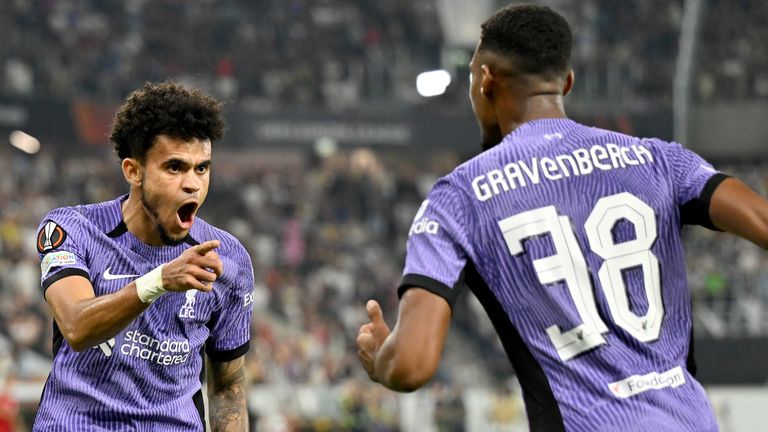
For example, when Liverpool — resplendent in their lavender kits (above) — took on LASK (which stands for Linzer Athletik-Sport-Klub, an Austrian professional football club) in group play for the regional football tournament, the Europa Cup, I streamed it, split-screen, on my laptop. On the right half of the screen was a tiny box streaming the action, and on the other, a manuscript I was editing and into which I had to try not to accidentally input “Nunez,” “Europa,” or “Diaz” while I listened to the announcers. I stopped editing and pulled the game onto the full screen when the Reds finally came alive in the 56th minute after Darwin Nunez scored a penalty kick, followed by Luis Diaz’s 63rd-minute tap-in. “Liverpool are alive and Liverpool are in the lead!” a commentator shouted. In the 88th minute, the always-reliable Mo Salah nutmegged (kicked the ball through an opposing player’s legs) a LASK player and scored in what a commentator said has become Liverpool’s “usual way:” a come-from-behind win.

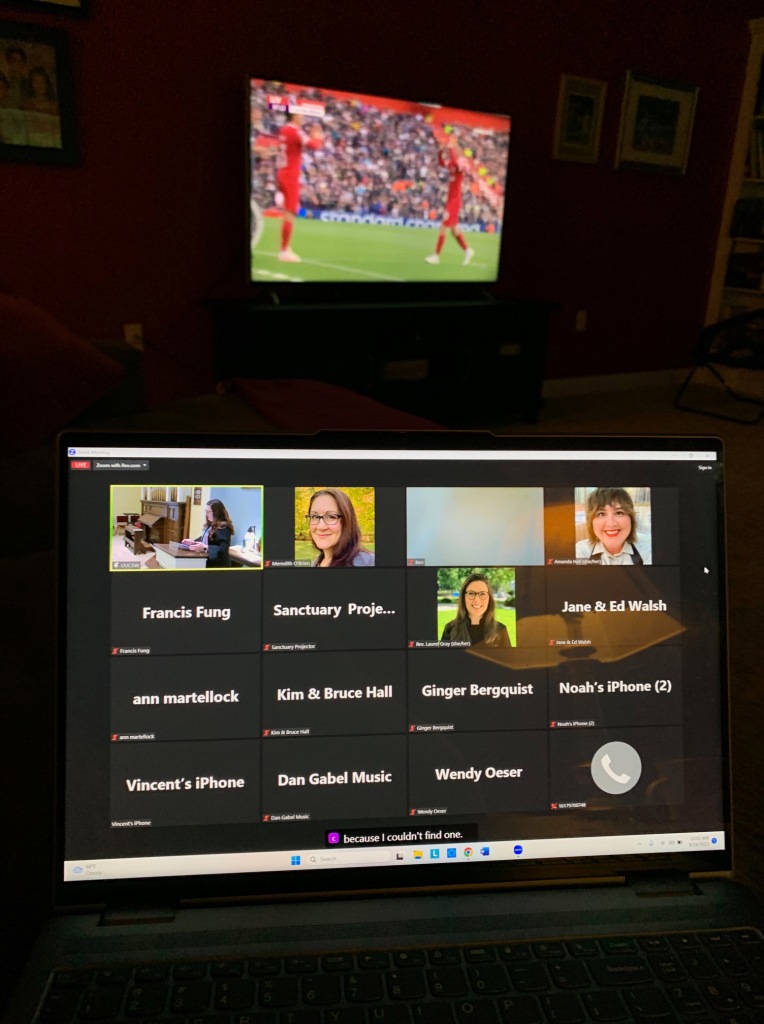
During the latest Liverpool game against West Ham United at home in Anfield, watching this 9 a.m. kickoff meant I had to juggle some things. My initial plan was to watch the first half at my house, drive to church, deposit myself in a back pew, and silently stream the second half from my phone. However, our Peacock account was maxed out on viewers so I wouldn’t be able to stream it. I had a choice to make: Church or Liverpool? Luckily, I could choose both because the Massachusetts church streams its services live. I watched the Liverpool game on the TV and church on my laptop. (See below) I texted Rev. Laurel — about whom I’m working on a book about being a Millennial minister — to explain my scheduling dilemma and she thought it was funny. I spent the second half petrified that I’d accidentally turn on my mic and have my cheers or my shouts of, “Shit!” ring through the church sanctuary speakers.
As has become rote thus far in Liverpool’s season, the club was cold at the beginning of the game, playing like they needed serious infusions of coffee (or tea, as they were playing in the land of tea). But the lackluster playing dissipated by the 16th minute when Salah easily scored on a PK. West Ham tied it by halftime, only to have Nunez score in impressive fashion in the 60th minute. Afterward, Nunez showily kissed his arms and wildly gestured toward the appreciative home crowd. I was even more impressed by the Diogo Jota goal in the 85th minute off of a very odd headed pass from Virgil van Dijk, who had just returned from a multi-game, red-card banishment.

Simultanously, my husband Scott was sitting across from me in the family room streaming the Chelsea game on his phone and my resident Chelsea fan son was in his room watching his preferred team, the Blues, which lost. And whenever Chelsea loses, a grumpy pall is cast over the house. No one is to speak about the game for at least 24 hours.
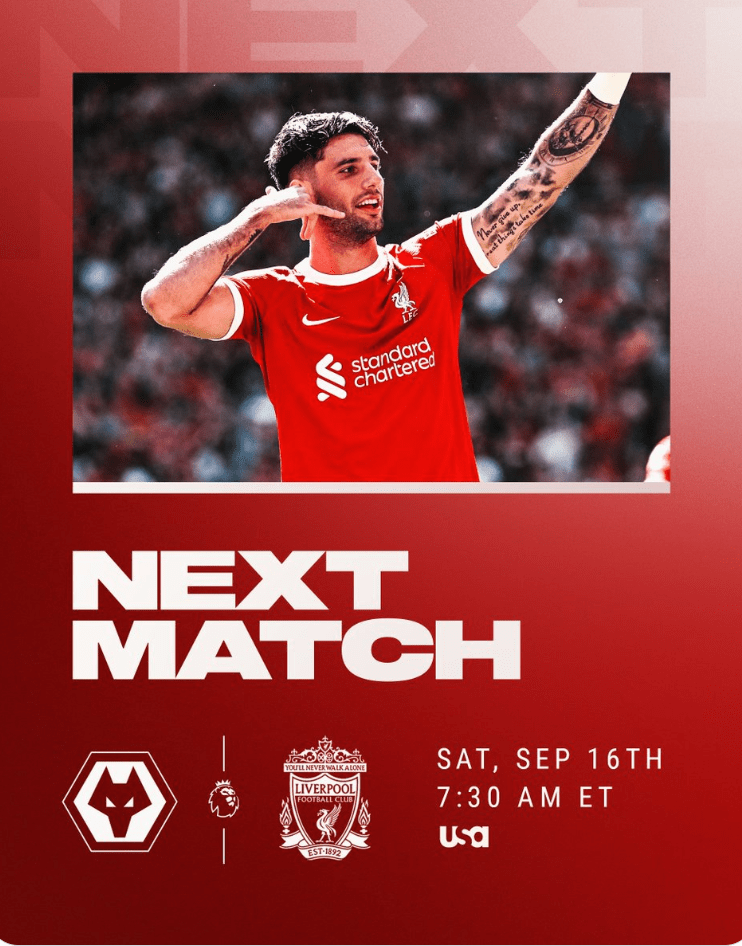
The only recent, Liverpool game to which I was able to devote my full attention was the Saturday, Sept. 16 match against the Wolves. That weekend, my house was filled with my three adult children and my daughter’s boyfriend. Football fans, all. We all got up early to watch the Liverpool game before I made dishes to bring to a family Rosh Hashanah dinner in the afternoon. (I made mini-potato kugels in cupcake tins, a salad whose components hailed from a local farm, and brought bottles of wine. My daughter baked an apple pie.) Outside, powerful winds from the dregs of Hurricane Lee which swept up the US East Coast, rattled the family room windows as rain poured intermittently. I gulped down several cups of coffee to wake myself up, seeing that the game kicked off at 7:30 a.m. Boston time.

The match began with the Reds playing … poorly. The Wolves were able to slice through their lackluster defense like a hot knife through butter. It was no surprise when the Wolves struck first, scoring the game’s first goal through the legs of Andy Robertson in the seventh minute. My ardent Liverpool fan son Jonah was edgy, 10 minutes in, “They’re on the ropes already!” For the bulk of the game, the Wolves’s lead felt more substantial than 1-nil because Liverpool was playing so badly.

Then … Salah.
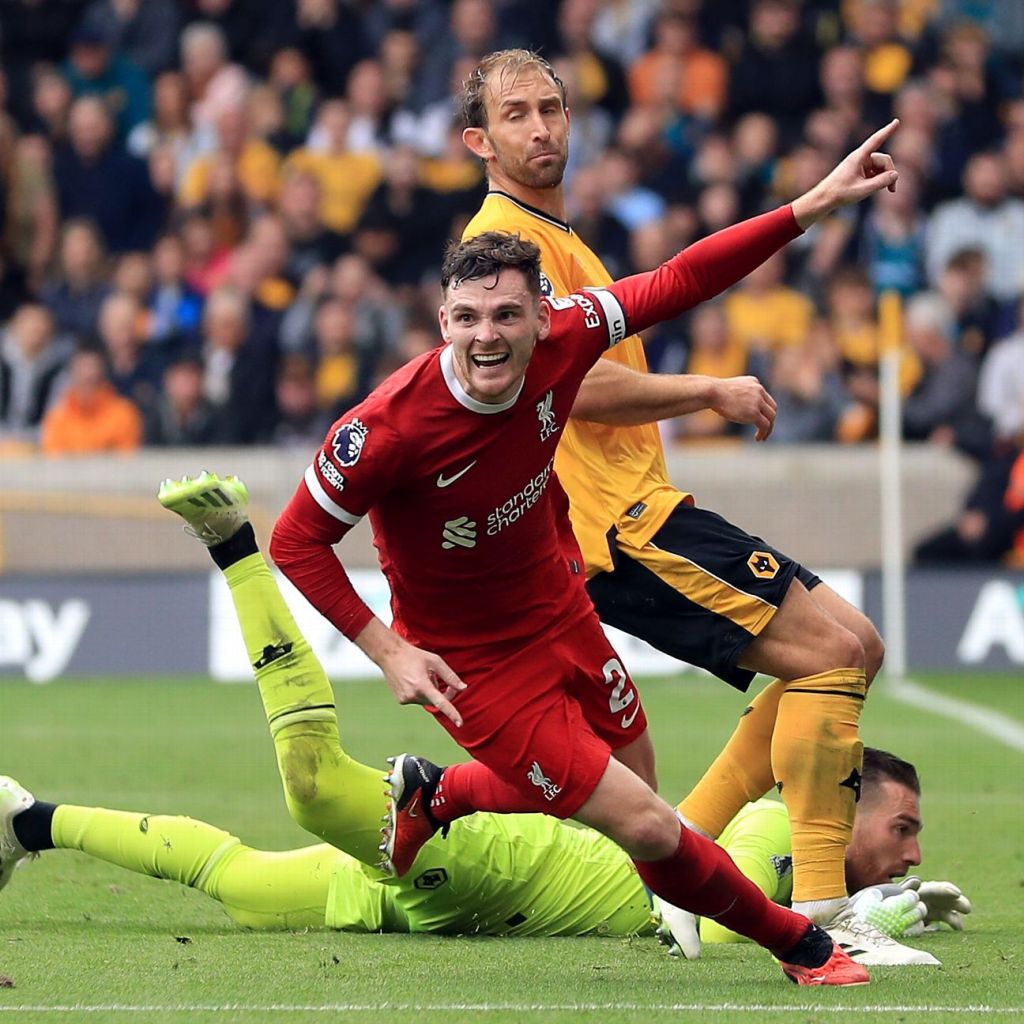
In the 55th minute, Salah sent Cody Gakpo the ball who converted it into the first Reds goal. Thirty minutes later, Robertson’s goal (pic above) caused Jonah to raise his right fist in triumph, “He NEVER scores!” The room’s dour mood shifted like quicksilver as a Liverpool W seemed possible. A Liverpool win was cemented by an unlucky own-goal by the Wolves’ Hugo Bueno (he accidentally tipped the ball into his team’s net) making it 3-1 Liverpool.

Next up for the Reds in the Prem: A match at Tottenham (my nephew’s favorite team) on Saturday, Sept. 30 at 12:30 ET.

Random bits:

  • I’ve now learned that it’s routine behavior for defensive players who are lining up to block a direct kick on goal, to not only protect their crotches, but to also jump vertically. Additionally, one player lies facing toward the goal — away from the opposing team’s kicker — should the kicker try to send the ball rolling on the pitch beneath the jumping defensemen. (This nugget of info was gleaned after I asked my kids, “Why is that dude lying on the ground?”)
  • Several weeks into the Premier League season, I haven’t quite memorized the Liverpool players’ names and often struggle to identify them on the pitch, especially if I’m not wearing my glasses. I’m working on it.
  • XG. Who knew that XG means “expected goals,” meaning, how many goals each team and/or player is expected to deliver in any given game? Everyone in my family except for me, the football newbie. I likened XG to a Major League Baseball pitcher’s ERA or a hitter’s batting average. However any time I liken football to baseball in my attempts to understand it, I get eye rolls. Nonetheless, I persist!

Image credits: Sky Sports, ESPN and Google.

adventures in british football: so many prem football questions

I’ve got questions. Lots of ‘em. Stupid questions, pointed questions, legit questions. Let’s start with the ones that’ve been really nagging me.

International breaks

Why are there so many breaks in the Premier League’s season? I’d never even heard of such a thing until the end of the last Liverpool game against Aston Villa, when announcers mentioned that the next game would occur AFTER the international break.

The international … what?

I did a round of internet sleuthing and learned that the English Premier League has loads of players who participate in the Euro Cup for their home countries’ teams, as well as for the Asia Cup and the Africa Cup of Nations, according to Metro UK. So the Prem accommodates them — most of them anyway — with breaks. Several of them, as outlined by the Metro:

So this led to my having to read up about the 2024 Euro Cup, for which national teams must endure months of qualifying rounds, similar to the World Cup. There are qualifying matches in September, October, and November before the semi-finals in March 2024 and finals in June and July.

I struggled to find a comparable situation in American professional sports. There are pauses, for example, for the World Cup in American pro soccer, but that’s only every four years, and, I believe their schedule isn’t affected by the World Cup, at least it wasn’t last year. With Major League Baseball, there’s a midseason break for the All-Star game and associated festivities; the World Baseball Classic takes place during MLB’s spring training so there’s no need for a league-wide break. One American professional sports league, the National Hockey League, refused to take a break from play before the 2022 winter Olympic games. The NBA similarly opted to keep the regular schedule going during the rescheduled 2021 summer Olympics, so the concept of multiple “international breaks” proved befuddling to this American fan.

What do the breaks mean for the Liverpool team, my chosen PL club? According to the team website, these players are participating in qualifiers for international teams:

  • Alexis MacAllister — Argentina
  • Alisson Becker — Bolivia
  • Luis Diaz — Colombia
  • Kostas Tsimikas — Greece 
  • Dominik Szoboszlai — Hungary
  • Caoimhin Kelleher — Ireland 
  • Cody Gakpo and VVD — Netherlands 
  • Diogo Jota — Portugal
  • Andy Robertson — Scotland
  • Darwin Nunez — Uruguay

“Trent Alexander-Arnold has withdrawn from England’s squad … due to injury,” according to Liverpool. Mo Salah is slated to play with Egypt in the Africa Cup qualifiers, the Reds’ site said, adding that Wataru Endo will join the Japanese team to play friendlies. But because the bulk of the Africa Cup runs from January through February — during which the Prem will only take a pause from Jan. 14-30 — that means if a player’s national team does well, that player could miss one or two Prem games, according to TalkSport.com. For Salah, the website reported he could miss Liverpool’s matches against Chelsea and Arsenal if Egypt’s national team is still alive in the Africa Cup’s later rounds.

Plural or singular?

Seeing that I’m a word nerd, it’s been bugging me to hear people refer to football teams’ host cities in the plural format. For example, when I discuss the Boston Red Sox, I say, “Boston is miserable this year.” I use a singular verb, “is.” Boston is one city. There is one baseball team represented by the name “Boston” in that sentence. However, when people discuss the Liverpool Football Club, I’ve noticed they say things like, “Liverpool are doing well so far.” The word “are” is generally used when describing the actions of more than one entity. The Liverpool Football Club is a singular organization.

Listening to people say, “Liverpool are winning,” is cramping my brain. It was during one such brain cramp when I wound up in a big argument with Chelsea-fan Casey about this very subject. He pointed out that I refer to the “Red Sox” in the plural form. (“The Red Sox are losing.”) I replied by saying using the word “are” makes sense when most American sports’ teams nicknames are plural, as in, more than one sock, more than one Yankee, more than one Patriot, etc. But when you’re talking about Liverpool or Chelsea, you’re only talking about one team. We went round and round for a while until my head ached and I wound up fleeing the room. When I took to the internet again, I discovered a site that proved football-mad Casey correct:

“In the Premier League, all football teams are singular in form (Arsenal, Manchester Utd, Chelsea),” said the website Premier Skills, “but, in British English, we use a plural form when we are referring to the football team and their actions. For example: ‘Arsenal are on the attack. Chelsea have won again.’”

Okay, Casey, you were right. Again. At least when it comes to how the English refer to their football clubs.

Names on jerseys (okay, they’re called ‘kits’ in the UK, and football cleats are called ‘boots’ but the spikes at the bottom are called ‘studs’ in England, I think … )

I was super confused a few weeks ago after Darwin Nunez came off the bench and scored Liverpool’s only two goals to defeat Newcastle. Why? Because his jersey has the name “Darwin” on the back. So when commentators started going on about “Nunez,” I was thinking, Who’s Nunez? Darwin is the one who scored. (I was similarly thrown when everyone was referring to the goalkeeper, Alisson Becker, as “Alisson,” but at least the back of his jersey says, “A. Becker.”)

Later, I learned that I was thinking like an American sports fan. In the US, players’ surnames are on the backs of their jerseys, not their first names or their nicknames. Red Sox legend David “Big Papi” Ortiz had “Ortiz” on the back of his jersey, not “Big Papi” or “David.”

Research informed me that if the Premier League gives its okay, players can put their first names or nicknames on their shirts. So when you mix in first names, nicknames, and surnames, that can lead to a lot of confusion to those new to the sport.

According to the Daily Mirror, the Prem’s rules about names on jerseys was “relaxed” in 2000. “Shirts should feature the player’s last name or such other name as approved in writing by the Premier League Board,” the Mirror reported. “These can be nicknames adopted from abroad which are more likely to be accepted if featured in other leagues.” 

Well, okay then. Another bizarre rule for this Yank to wrap her head around, along with messed-up verb tenses and more breaks than an American member of Congress. Onto Saturday’s match.

Image credits: Metro UK, Liverpool FC’s website, and Liverpool FC’s Twitter feed.

adventures in british football, week two: liverpool beats bournemouth at anfield

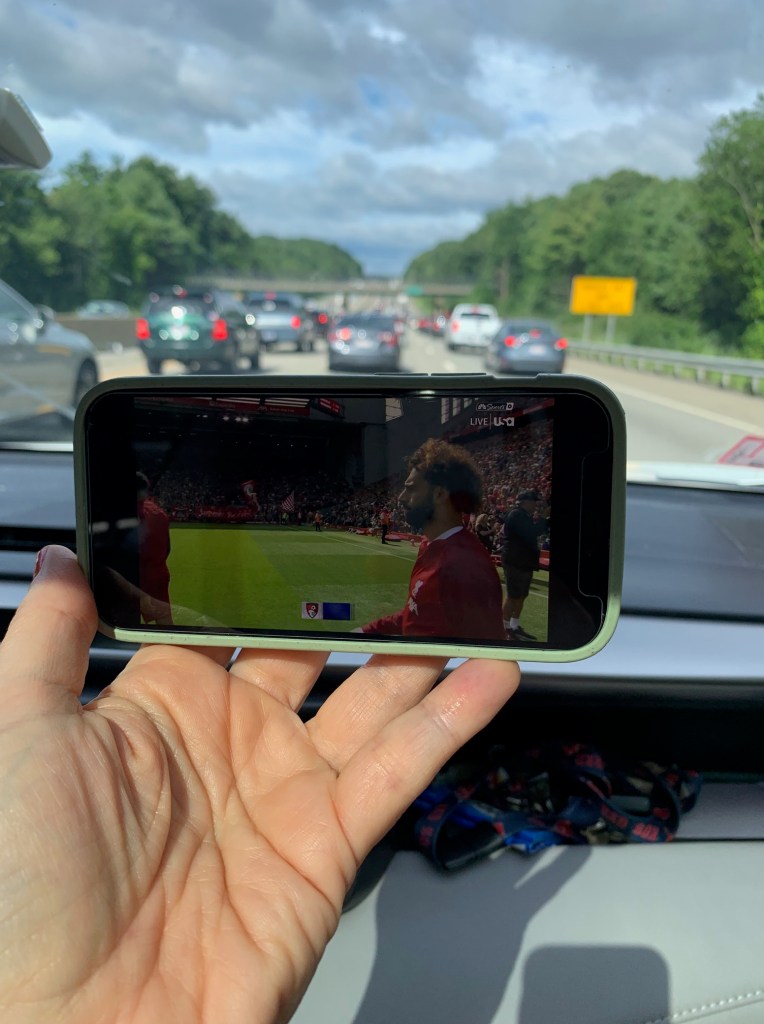
During my second week of watching the Prem as a Liverpool fan — I was told to stop writing the “Premier League” because it makes me sound like the football newbie that I am — I had to do so on a tiny cell phone screen because I was joining my husband Scott and my Liverpool fan son Jonah to move my Liverpool fan daughter Abbey’s belongings to her new apartment in the Bronx as she starts a Physician Assistant Program. Abbey, who attended a Liverpool game at Anfield in May and likened its atmosphere to my beloved Fenway Park, drove and listened to the Liverpool v Bournemouth match audio while I rode shotgun and held aloft that diminutive screen.

It was definitely an inferior experience watching the game a cell phone while keeping an eye on the other two vehicles in our move-Abbey-to-the-Bronx caravan. Additionally, I couldn’t totally get into the spirit of things because I wasn’t wearing my brand new (retro version) Liverpool jersey which had recently arrived because I didn’t want it sullied as I unpacked boxes. Instead, I opted to live dangerously by wearing a Boston Red Sox tee while the Sox were playing — and beating — the New York Yankees just a few miles away from Abbey’s new digs at Yankee Stadium.

As for Liverpool’s come-from-behind 3-1 victory, it was initially quite grim inside our vehicle as not only were we stuck in atrocious traffic from Boston to NYC, but we were witnessing Bournemouth land two shots on target and one goal in the match’s opening minutes. And Liverpool, as an entity, was playing like a wet dish towel. I kept thinking about the video Jonah had shown me hours before in our kitchen, where Liverpool scored nine goals against the Cherries in a prior season. Had we unknowingly jinxed the game by musing about a possible repeat performance? I’d had Jonah knock on wood because, well, I can be a tad superstitious.

Feeling as though, after my reading about and watching of EPL football, I could speak with a teeny bit of verve about the match, I started live-tweeting. Luckily, after my first disgruntled post — “WTF @LFC @LFCUSA? Good God. Is this going to be a 9-1 but with the Reds on the wrong end? @premierleague” (the 2022 game was 9-0, I later learned, but you can’t edit tweets) — things started looking up. As Eurosport put it, “It took Liverpool half an hour to wake up but they hit two [goals] in nine minutes thanks to [Mo] Salah and an acrobatic finish from Luis Diaz.”

That Diaz goal, a quasi-bicycle kick move … a chef’s kiss of deliciousness to lift the gloom inside our vehicle as we remained stuck in stubborn traffic. Add in Salah’s goal on the rebound after his penalty kick (PK) was saved, and Abbey and I went into halftime quite happy.

Even though I’m quite new to British football, I thought the red card issued to Alexis MacAllister was bogus. Here’s what I wrote in my Notes app on my phone while watching the game on my daughter’s microscopic iPhone: “MacAllister gets bad red card. No malice. Learned that they [Liverpool] had to now play with 10 [players].” Another new football rule I filed into the recesses of my brain: red card = playing with only 10.

The issuance of that card came just 24 hours after Abbey, who’d been packing up her childhood room (!), came across the red and yellow card packet she had from her youth soccer reffing days. She never did find the right moment to flash either color card. However after watching the video of the controversial call (after our caravan took a breather at a rest area) former youth soccer ref Abbey concurred that it should’ve been a yellow.

The least surprising response to this red blunder came from my football-mad, Chelsea-supporting son Casey who did not make the trip with us. Via text, he said he agreed with the ref, adding that MacAllister’s studs were up and over a foot off the ground, a clear violation of the rules, which he’s read thoroughly. Two days later, I sent Casey a screenshot of an Instagram post from a (biased) Liverpool fan site, LFC Newsroom: “As widely expected by everyone with reasonably adequate eyesight, LFC have formally appealed for Alexis MacAllister’s red card to be overturned. … Surely it gets overturned. It was a clear mistake by the referee to give MacAllister a red card, even Bournemouth manager Andoni Iraola said it wasn’t a red card.”

Those anti-red card folks were vindicated when the call was later overturned. I may have gloated (*I absolutely did*) in my family’s group text. Score one for the football novice.

Other tidbits:

Red = angry: The MacAllister red card seemed to inspire Liverpool to play a more aggressive style of football in the second half against Bournemouth, fueling a barrage of powerful shots. After the beginning of the game during which it seemed like the Reds were sleepwalking, this was refreshing.

Salah staying put: For the past few days, the internet has trembled with rumors that Salah was being wooed to leave Liverpool with the lure of a massive paycheck. Fortunately, those rumors have been dispelled. For now. (*fingers crossed and knocking on wood*)

Now, it’s onto the dangerous Newcastle team at St. James Park on Sunday. I’ll be wearing my Liverpool red!

Image credits: EuroSport/Getty and LFC Newsroom.