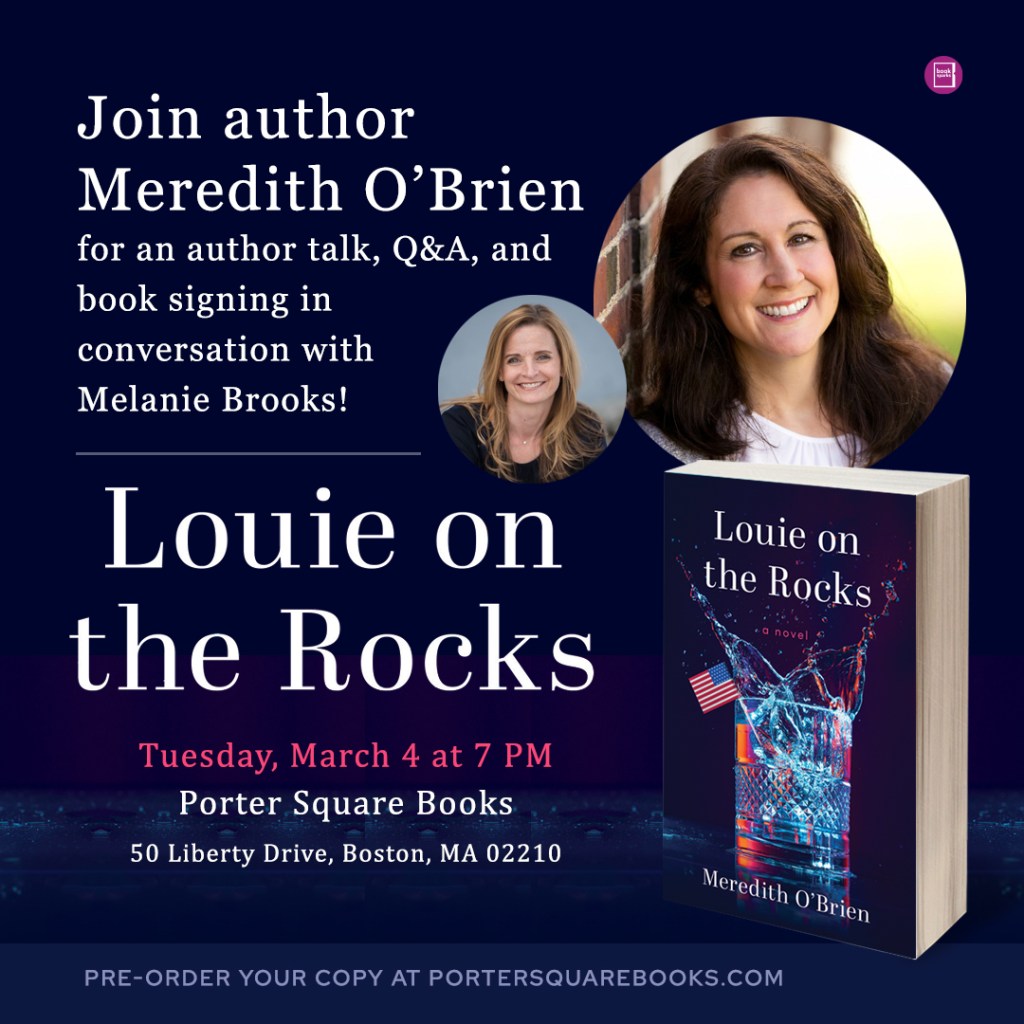
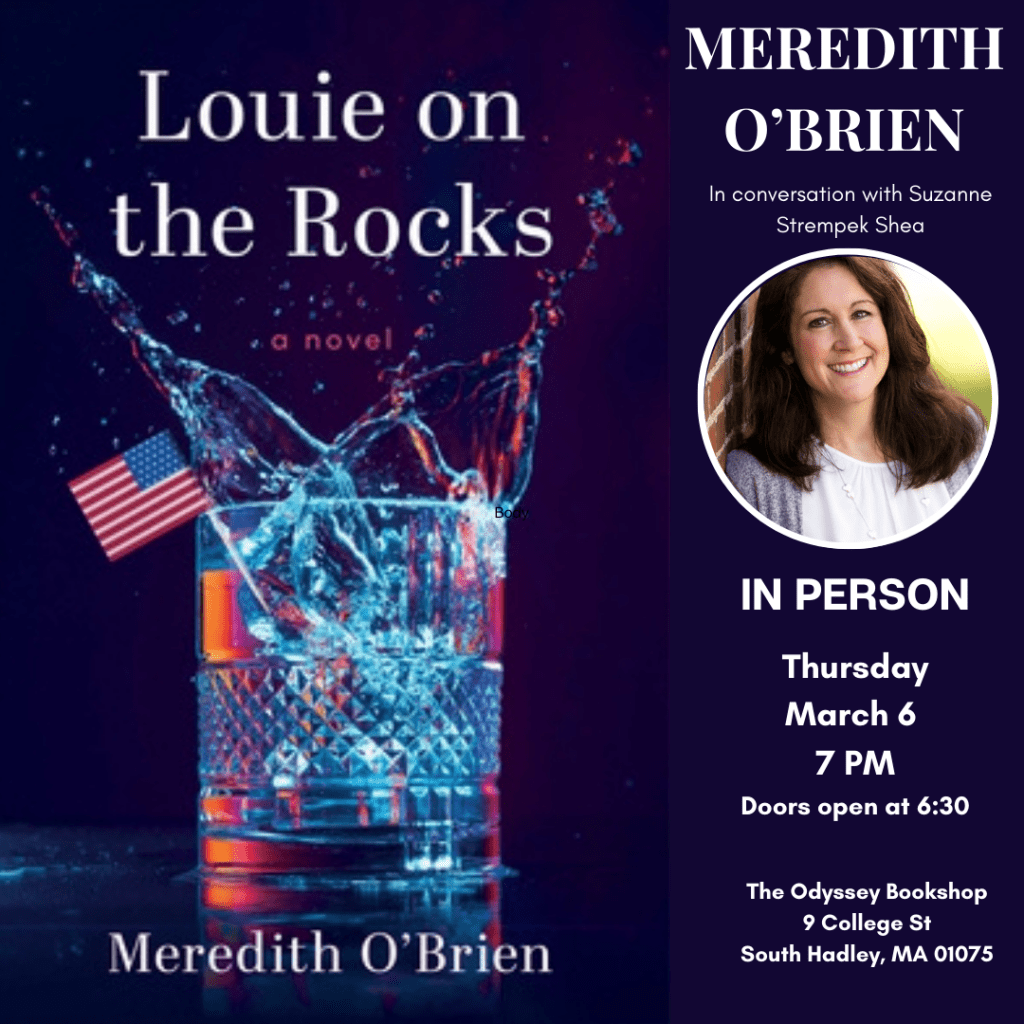
Lots of book events coming up to promote Louie on the Rocks.
Incredible writers — with connections to western Massachusetts, to UMass Amherst, and to Bay Path University’s MFA program in creative nonfiction — have graciously agreed to appear with me. I’m very appreciative of their time.
It’s been a crazy couple of weeks in my world. There’ve been three Liverpool games since the last time I blogged. And they’ve won them all. Beating the Wolves in a come-from-behind win, 3-1. Beating LASK in Europa Cup group match, 3-1. Beating West Ham, in a come-from-behind win, 3-1. Hmm, sensing a trend?
Keeping up with all of this football has been fairly challenging when one is trying to do something called life. I’m teaching, three, college-level courses (all writing classes) which involve a tremendous amount of input and a lot of class prep. Throw in the fact that I’ve got several ongoing writing projects — including organizing my research for a new book and editing my second fiction manuscript — as well as a Rosh Hashanah celebration with the extended family, and attending in-person Boston Red Sox games (my favorite team), and, I don’t know, inconsequential things like sleeping and eating … and things have been a touch chaotic. Shoehorning Liverpool’s Prem games, plus games for other competitions like the Europa Cup, into my daily life, was much simpler before the fall semester began.
To watch the last two Liverpool games required serious multitasking on my part, something I have to imagine many American fans need to accomplish in order to follow football matches taking place on another continent, during hours when Americans would typically be working. Or sleeping.
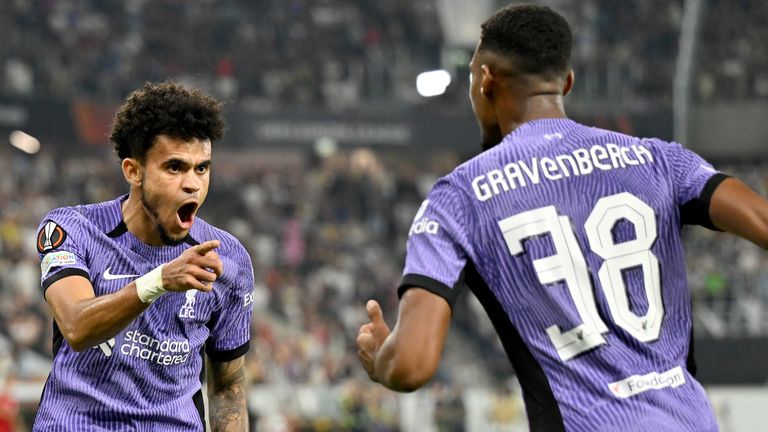
For example, when Liverpool — resplendent in their lavender kits (above) — took on LASK (which stands for Linzer Athletik-Sport-Klub, an Austrian professional football club) in group play for the regional football tournament, the Europa Cup, I streamed it, split-screen, on my laptop. On the right half of the screen was a tiny box streaming the action, and on the other, a manuscript I was editing and into which I had to try not to accidentally input “Nunez,” “Europa,” or “Diaz” while I listened to the announcers. I stopped editing and pulled the game onto the full screen when the Reds finally came alive in the 56th minute after Darwin Nunez scored a penalty kick, followed by Luis Diaz’s 63rd-minute tap-in. “Liverpool are alive and Liverpool are in the lead!” a commentator shouted. In the 88th minute, the always-reliable Mo Salah nutmegged (kicked the ball through an opposing player’s legs) a LASK player and scored in what a commentator said has become Liverpool’s “usual way:” a come-from-behind win.
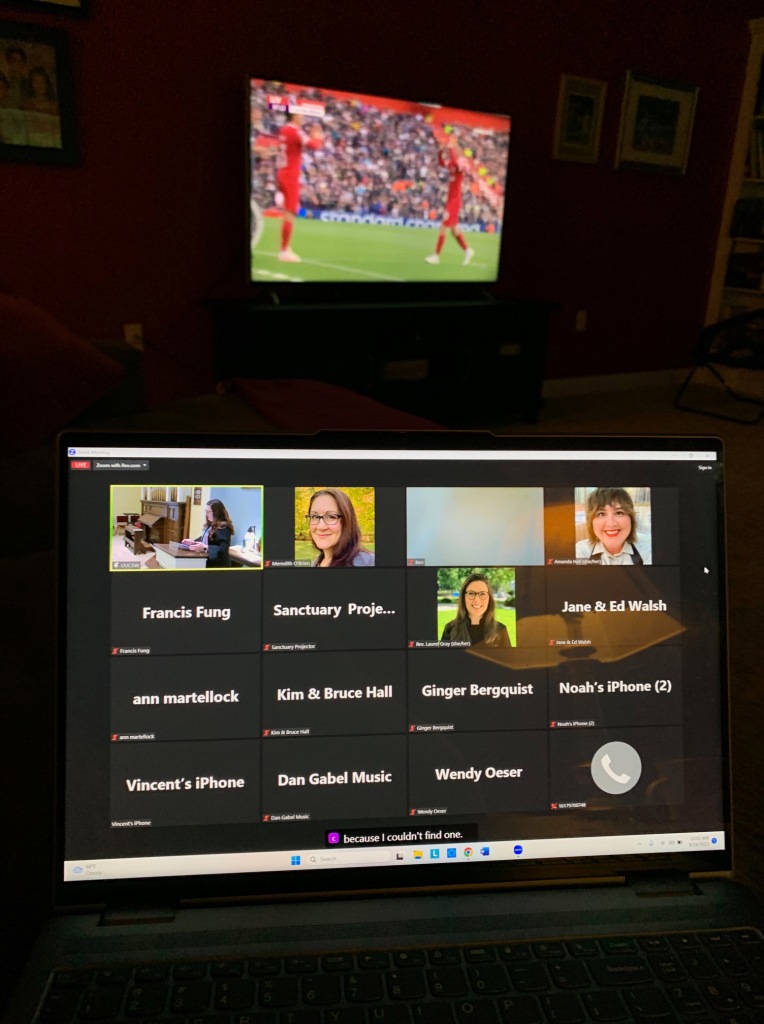
During the latest Liverpool game against West Ham United at home in Anfield, watching this 9 a.m. kickoff meant I had to juggle some things. My initial plan was to watch the first half at my house, drive to church, deposit myself in a back pew, and silently stream the second half from my phone. However, our Peacock account was maxed out on viewers so I wouldn’t be able to stream it. I had a choice to make: Church or Liverpool? Luckily, I could choose both because the Massachusetts church streams its services live. I watched the Liverpool game on the TV and church on my laptop. (See below) I texted Rev. Laurel — about whom I’m working on a book about being a Millennial minister — to explain my scheduling dilemma and she thought it was funny. I spent the second half petrified that I’d accidentally turn on my mic and have my cheers or my shouts of, “Shit!” ring through the church sanctuary speakers.
As has become rote thus far in Liverpool’s season, the club was cold at the beginning of the game, playing like they needed serious infusions of coffee (or tea, as they were playing in the land of tea). But the lackluster playing dissipated by the 16th minute when Salah easily scored on a PK. West Ham tied it by halftime, only to have Nunez score in impressive fashion in the 60th minute. Afterward, Nunez showily kissed his arms and wildly gestured toward the appreciative home crowd. I was even more impressed by the Diogo Jota goal in the 85th minute off of a very odd headed pass from Virgil van Dijk, who had just returned from a multi-game, red-card banishment.
Simultanously, my husband Scott was sitting across from me in the family room streaming the Chelsea game on his phone and my resident Chelsea fan son was in his room watching his preferred team, the Blues, which lost. And whenever Chelsea loses, a grumpy pall is cast over the house. No one is to speak about the game for at least 24 hours.
The only recent, Liverpool game to which I was able to devote my full attention was the Saturday, Sept. 16 match against the Wolves. That weekend, my house was filled with my three adult children and my daughter’s boyfriend. Football fans, all. We all got up early to watch the Liverpool game before I made dishes to bring to a family Rosh Hashanah dinner in the afternoon. (I made mini-potato kugels in cupcake tins, a salad whose components hailed from a local farm, and brought bottles of wine. My daughter baked an apple pie.) Outside, powerful winds from the dregs of Hurricane Lee which swept up the US East Coast, rattled the family room windows as rain poured intermittently. I gulped down several cups of coffee to wake myself up, seeing that the game kicked off at 7:30 a.m. Boston time.
The match began with the Reds playing … poorly. The Wolves were able to slice through their lackluster defense like a hot knife through butter. It was no surprise when the Wolves struck first, scoring the game’s first goal through the legs of Andy Robertson in the seventh minute. My ardent Liverpool fan son Jonah was edgy, 10 minutes in, “They’re on the ropes already!” For the bulk of the game, the Wolves’s lead felt more substantial than 1-nil because Liverpool was playing so badly.
Then … Salah.
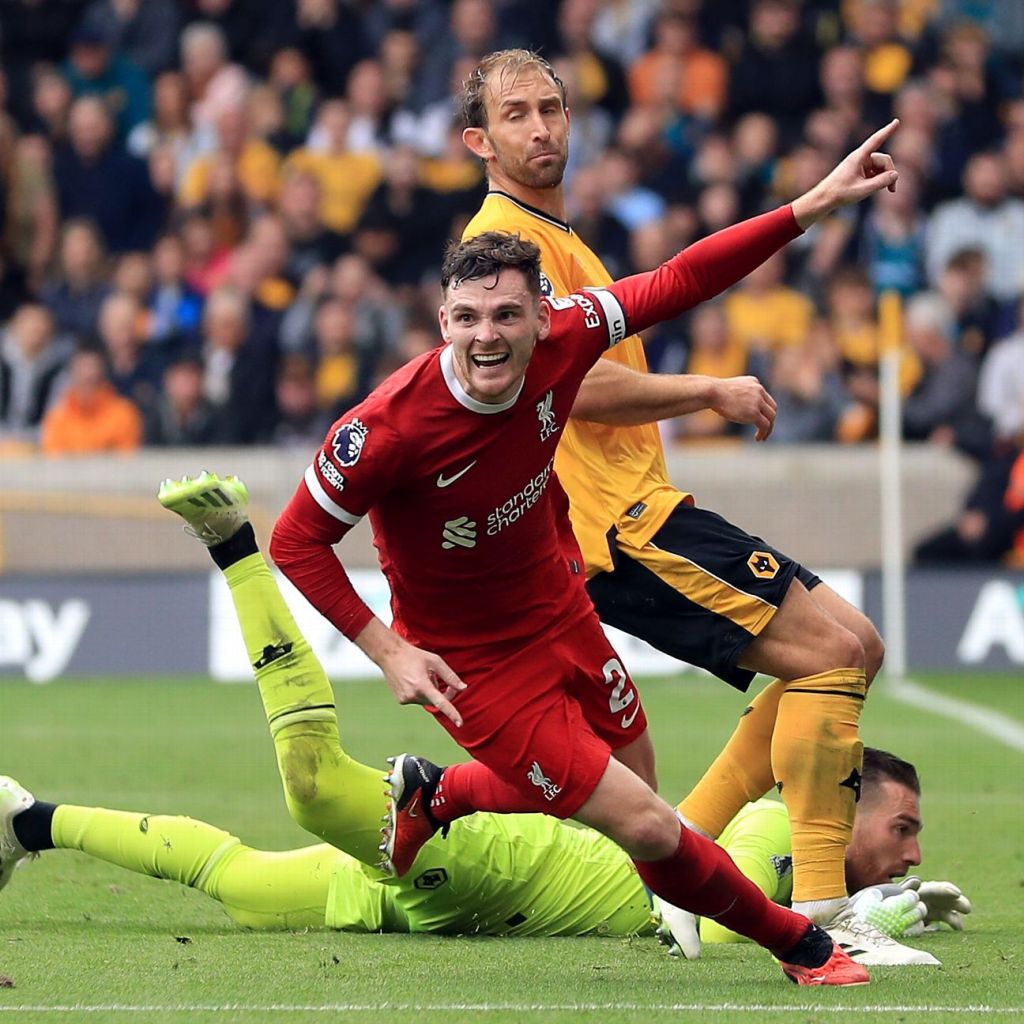
In the 55th minute, Salah sent Cody Gakpo the ball who converted it into the first Reds goal. Thirty minutes later, Robertson’s goal (pic above) caused Jonah to raise his right fist in triumph, “He NEVER scores!” The room’s dour mood shifted like quicksilver as a Liverpool W seemed possible. A Liverpool win was cemented by an unlucky own-goal by the Wolves’ Hugo Bueno (he accidentally tipped the ball into his team’s net) making it 3-1 Liverpool.
Next up for the Reds in the Prem: A match at Tottenham (my nephew’s favorite team) on Saturday, Sept. 30 at 12:30 ET.
Random bits:
I’ve now learned that it’s routine behavior for defensive players who are lining up to block a direct kick on goal, to not only protect their crotches, but to also jump vertically. Additionally, one player lies facing toward the goal — away from the opposing team’s kicker — should the kicker try to send the ball rolling on the pitch beneath the jumping defensemen. (This nugget of info was gleaned after I asked my kids, “Why is that dude lying on the ground?”)
Several weeks into the Premier League season, I haven’t quite memorized the Liverpool players’ names and often struggle to identify them on the pitch, especially if I’m not wearing my glasses. I’m working on it.
XG. Who knew that XG means “expected goals,” meaning, how many goals each team and/or player is expected to deliver in any given game? Everyone in my family except for me, the football newbie. I likened XG to a Major League Baseball pitcher’s ERA or a hitter’s batting average. However any time I liken football to baseball in my attempts to understand it, I get eye rolls. Nonetheless, I persist!
Participants: My then-24-year-old grad student son, my then-21-year-old undergrad son, my spouse, and me (if you can call me a participant).
Subject: Whether a bicycle kick by a Southampton football club player to the head of Chelsea’s football club’s captain warranted a red or yellow card.
For the entirety of our lunch before we headed to campus to see the University of Massachusetts’ men’s hockey game, I could not work my way into the conversation, not during drinks, not during appetizers, not during the main meal, not even during dessert. I couldn’t get the three male members of my family to change the subject to something in which I was conversant, like U.S. politics or the spy balloon that’d been flying over the U.S. or pop culture. Since I couldn’t take part in their animated debate because I had nothing to contribute, I pulled out my phone and began taking notes. Some of the gems they uttered:
What kind of crack are you on?
You’re asking the wrong questions!
You can usually, visually gauge intent!
Just because it’s subjective, doesn’t mean it’s crap.
That’s one of your dumbest takes ever.
The old fashioned I rapidly drained while chronicling their conversation didn’t chill me out nearly enough to cope with, what I described as, “this all-encompassing conversation where all the oxygen goes to British, fucking, soccer.”
By the end of the meal I reached a decision: In order to engage with them, I need to join them. I need to become the last member of my family of five to select a Premier League team and rabidly root for it, because what is British soccer without the rabidness of its fans? My daughter, like her twin brother, is a Liverpool fan. My younger son is a Chelsea fan. My husband tries (rather unsuccessfully) to be the human equivalent of Switzerland, someone who claims to be fans of both teams, but his poker face isn’t as good as he thinks it is.
Personally, I never cared much about soccer – hereafter known called football – aside from watching the U.S. Women’s National Team in World Cup or Olympic matches. A lifelong Boston Red Sox fan who weathered many losing years (1986 … just … no) before the gloriously historic 2004 season which snapped an 86-year losing streak, I’ve also enthusiastically followed my alma mater’s teams (specifically University of Massachusetts hoops and hockey). A fair-weather Celtics fan, I don’t really follow the Boston Bruins or the New England Patriots, although if friends and family gather to watch a big game, I’ll watch with them.
But European football … I’ve never really understood why my family is so enthralled with it and why my late-sleeping sons willingly rise early ON WEEKENDS to watch matches. However, following that aggravating lunch at Johnny’s Tavern in February, I decided I need to figure out why.
I announced to my football-mad relatives that I’d follow the U.K. Premier League when it starts its season in mid-August. I then asked for input on which team I should follow – I didn’t want to choose between my kids’ favorites – adding that I was looking for a club with history, heart, authentic fan passion, and a bit of an underdog vibe. I wanted to ally with folks similar to loyal Red Sox fans. For example, if I hadn’t been born a Red Sox fan, I’d likely follow the Chicago Cubs because I admire their grit and undying loyalty to their club even after enduring 108 long years before they won the World Series in 2016.
Casey, the Chelsea fan, suggested I root for Aston Villa, a 149-year-old football team from Birmingham because he said the club represents the qualities I named: history, passion, and an upward trajectory in the league.
Jonah, my Liverpool-loving son, argued for Newcastle United because he said they’re moving up in the Premier League.
Abbey, my Liverpool-loving daughter, and Anthony, her Manchester United-loving boyfriend, argued for Brighton because they said Brighton is “kind of an up-and-coming team” and “they’re decently placed in the league and unlikely to be relegated … plus, nobody really hates them that much.”
Although they did offer suggestions, Abbey and Jonah made me rethink my approach of selecting a Premier League team out of thin air in order to try to understand the undeniable gravitational pull of British football fandom.
Why, they asked, didn’t I just root for Liverpool, which is owned the Fenway Sports Group, named after Fenway Park, the home of the Boston Red Sox? Liverpool’s connection to the Sox is, afterall, how they became Reds fans in the first place. I didn’t have a good response other than to repeat the mantra that I was hesitant to pick favorites between my children.
I did some research and had a lot of conversations about the Premier League. What I ultimately realized is that I couldn’t artificially muster enthusiasm for a club which, on paper, might seem like as if it meets my criteria. I wasn’t feeling it for any of the teams they suggested, and if there’s one thing I’ve learned from watching my family go football crazy, it’s that emotional connection is paramount. I couldn’t deny the pull of the name “Fenway,” in spite of the current, seriously lackluster Boston Red Sox season. After thinking about all these factors, as well as watching videos of Liverpool fans singing — as if they are one, thoroughly off-key body — the club’s unofficial theme song, “You’ll Never Walk Alone,” I couldn’t help but sense some “Sweet Caroline” kindred-spirit magic.
Starting on the morning of Sunday, August 13, when Liverpool faces off against Chelsea at 11:30 a.m. Boston time, I’ll be rooting for the Reds. Part of me will feel as though I’ve chosen Abbey and Jonah over Casey, however, I hope Casey will be pacified by my promise to root for the Blues whenever they’re playing any other club other than Liverpool (which Jonah says is indicative of the fact that I won’t be a “true” Liverpool fan … let the shit-talking begin).
My football learning curve will be steep. I’ll likely mess up the lingo and offer myriad bone-headed takes, but that’s what happens when you start something new. Just know that I’m drawn to the passion that formed an infuriatingly impermeable wall of verbiage at that lunch table in late winter, and I want to be part of the conversation.
Over the weekend, I was alerted to the fact that a TikTok video viewed by millions used my author photo as the face of taco salad orderers everywhere.
Um …
Okay … I guess that’s right, because I do order taco salads. Having a severe dairy allergy kind of mandates that I select the safer option when ordering at a cheese-laden Mexican restaurant.
The comments beneath the video — which made me feel my creaky middle age — spurred me to write an oped about the experience of having my face used in a viral TikTok video.
The experience reminded me of the time when, on Christmas 2020, a student of mine let me know that my photo had been used by a YouTuber who wanted to “infiltrate” neighborhood Facebook groups using a fake account using my supposedly trustworthy face.
Here’s the link to the oped published today in the Boston Globe:
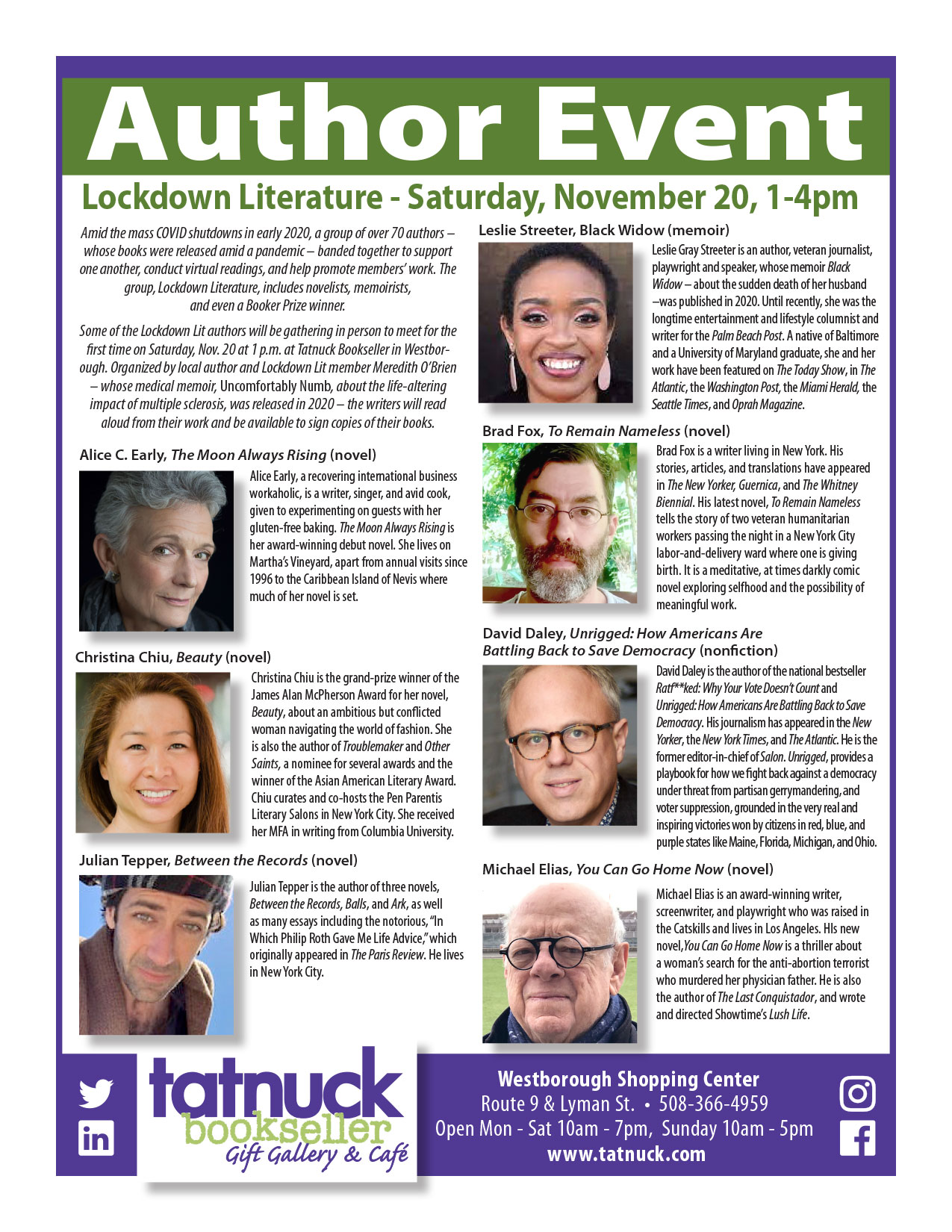
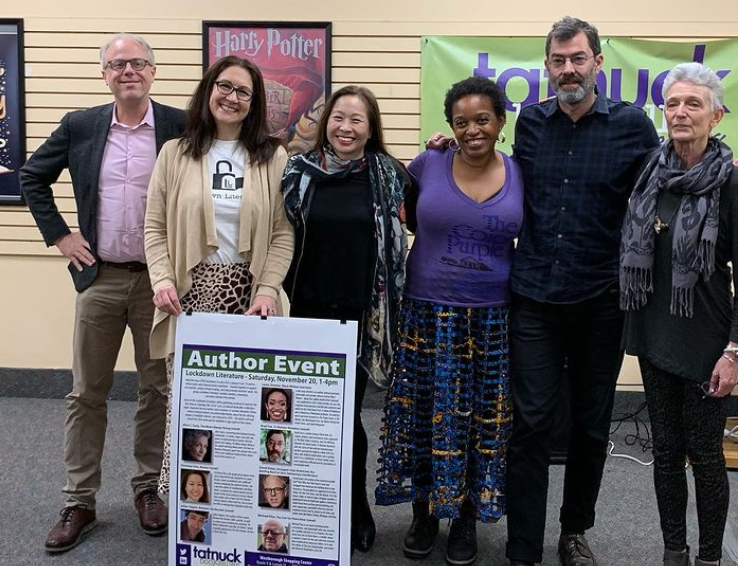
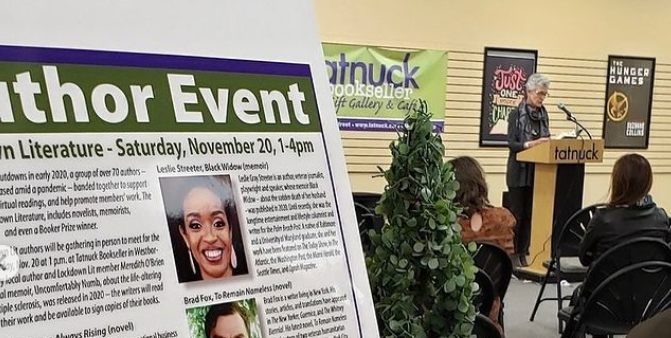
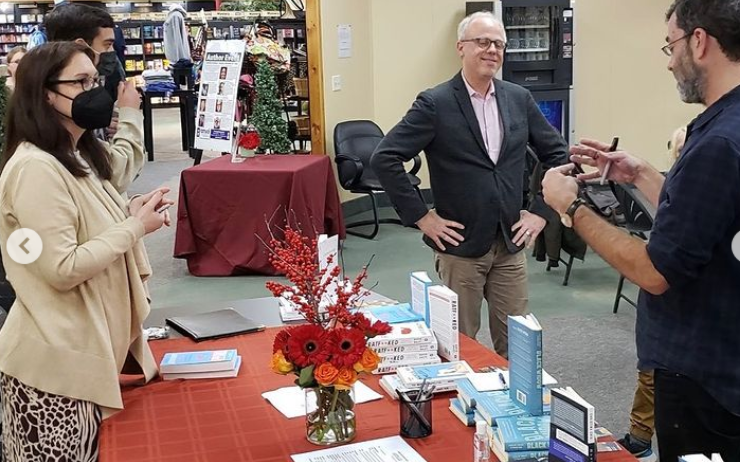
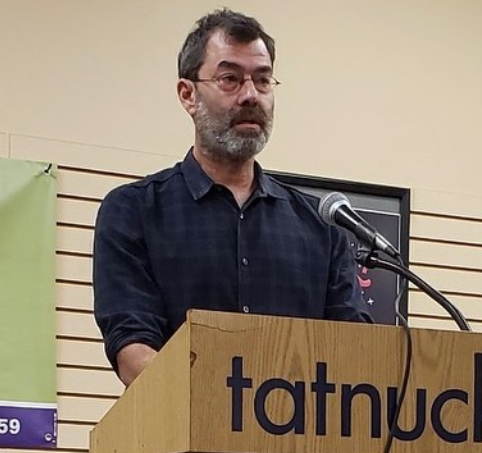
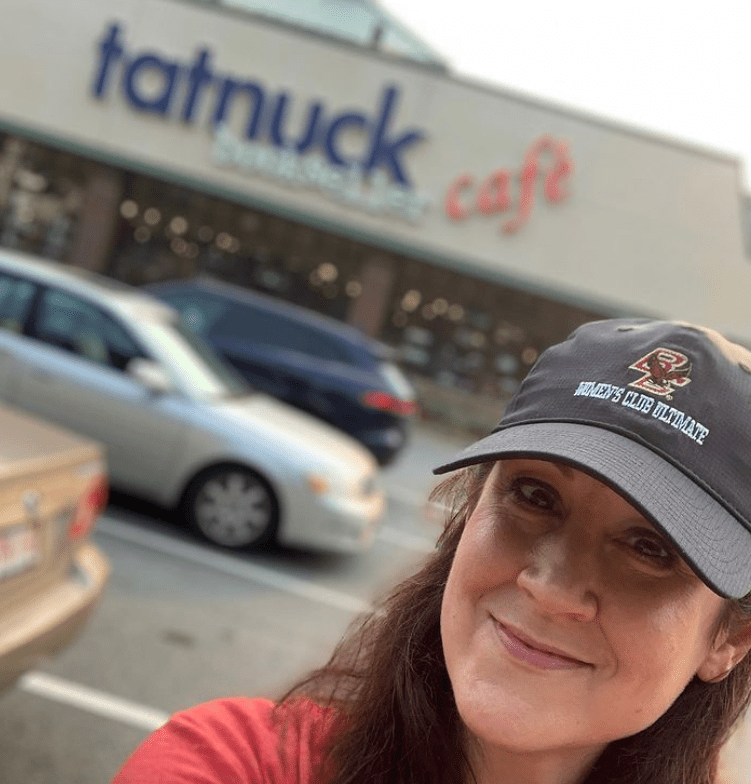
I have been remiss in posting about the wonderful literary event which took place at one of my favorite indie bookshops — Tatnuck Bookseller in Westborough, Mass. — featuring members of the Lockdown Literature writers’ group.
You may recall that during the shutdowns of 2020, I banded together with a group of 70+ authors whose books, like my medical memoir, were being released in the midst of an historic pandemic. Our group included writers of memoirs and nonfiction, of dark novels and wry works of contemporary fiction. We hailed from the east coast and the west, from overseas, and even included a superstar author who won all the big 2020 literary prizes (I’m talking about Douglas Stuart of Shuggie Bain fame).
I was incredibly honored to arrange to have some Lockdown Lit folks gather — just prior to the omicron COVID-19 surge — gather and read aloud from their work at Tatnuck Bookseller. Those talented writers included:
I was honored to be invited to serve as a fellow for the Disability Justice Project. As part of my work with the group, I’ll serve as a mentor to a journalist as she works on journalistic projects.
The Disability Justice Project (DJP) is a strategic partnership between the Disability Rights Fund, an international NGO funding grassroots organizations of persons with disabilities (OPDs) in the Global South, and journalism educator and human rights filmmaker Jody Santos and other nationally recognized media makers from Northeastern University’s School of Journalism in Boston, Massachusetts. Based on a fellowship model, newer professionals with lived experience of disability from the Global South are paired with mentors/professional journalists in the U.S. In an exchange of ideas and experiences, the fellows learn about digital storytelling from some of the best in the industry, while the mentors learn about the global disability justice movement from frontline activists – with the goal of incorporating that new understanding into their reporting for publications like The New York Times and The Guardian or for broadcasters like PBS and ABC.
The group recently ran a feature story about me as I’m writer and journalism faculty member who has a disability (multiple sclerosis). The article entitled, “Meet DJP Mentor Meredith O’Brien,” began:
Disability Justice Project mentor Meredith O’Brien has always loved reading and writing. “As a kid, I was often reading and trying my hand at writing little stories,” she says. “I’d find notebooks around the house and just start writing stories in them.”
The Westborough, Mass. independent bookstore where I’ve held book events and which sells signed copies of my books, has now created a local authors page.
What does this mean?
You can purchase copies of Meredith’s books online AND support an independent bookstore to boot.
When you buy Mr. Clark’s Big Band for your teacher or music friend, when you grab a copy of a medical memoir — Uncomfortably Numb — about what happens when one’s life is involuntarily upended by illness, or you are seeking a darkly humorous novel — Mortified — about a thirtysomething mommy blogger who reveals TMI about her family and lands into hot water, you can feel good about supporting an independent publisher (Wyatt-MacKenzie), and an indie bookshop.
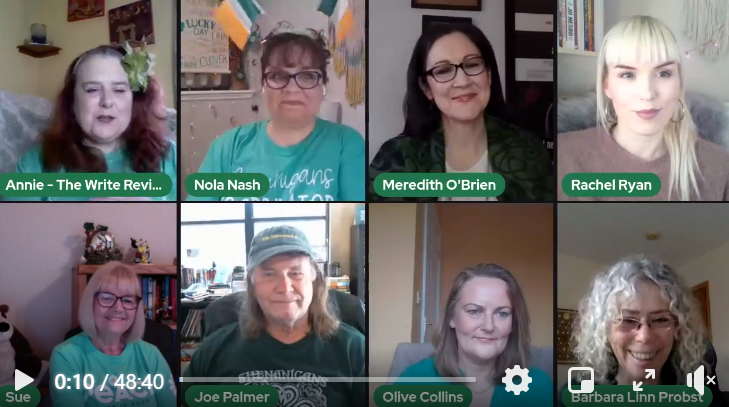
Facebook-based book groups The Write Review and Sue’s Reading Neighborhood teamed up with six other book groups to create a virtual, day-long St. Patrick’s Day “parade” of authors. Since we can’t stand on the sidewalks to watch live St. Patrick’s Day parades anywhere due to the coronavirus, this was the next best thing, plus it gave us the opportunity to speak with authors who are in Ireland right now, while we’re stateside. The Irish Echo even ran a feature story about the unusual, COVID-era event.
I appeared on a panel where the writers discussed the “Irish DNA” in our work. The night before the panel, I looked over my four books and discovered that there’s Irishness deep within the bones of each, in one way or another.
The only explicit reference to my Irish connection (via my father’s father), was found in my collection of humor/parenting columns in my book A Suburban Mom: Notes from the Asylumwhere I included a piece called, “Celebrating St. Patrick’s Day with All-American mutts.” In it, I talk about how my husband and I served our three young kids the same corned beef, cabbage and Irish soda bread my family used to eat every March 17 (full disclosure: my husband almost always made the corned beef.) While Scott took care of the corned beef, I’d have the kids create shamrock-themed crafts while I blasted U2 and the Dropkick Murphys (“Shipping Up to Boston” of course) as Scott and I enjoyed Guinness. That was usually followed by the kids’ consumption of super-sweet shamrock shaped cookies with sprinkles set atop their shamrock paper plates. One year, Scott and I took them to South Boston, where my brother lived at the time, to watch the famous Southie St. Patrick’s Day parade, not too far away from the L Street diner, which was featured in “Good Will Hunting.”
My next book, Mortified: a novel about oversharing, didn’t explicitly have Irish references, although the main characters were Irish. You had Michael Kelly who married Maggie Finn, whose mother was Molly Mahoney, whose mother Emily had lace curtains in the window. The novel was set in a suburb outside of Boston, an area where Irishness is deeply felt. When I was a newspaper reporter for a brief time, covering Boston City Hall in 1998, I was frequently asked, “What county are you from?” I’d wrinkle my brow, recall the western Massachusetts county where I was raised (Hampden), but then realized they meant from which IRISH county did my family hail (Cork).
Years later, my two works of narrative nonfiction included Irishness not only because the second one, Uncomfortably Numb: a memoir, was my story and I have Irish heritage, but because both books made frequent reference to Jamison Clark, the main character ofMr. Clark’s Big Band: A Year of Laughter, Tears and Jazz in a Middle School Band Room. He not only was the hero in Mr. Clark’s Big Band, but he appeared at the beginning (and the end) of Uncomfortably Numb as he was there when I first experienced numbness in my left leg. During one of my first long interviews with him (the one with the numbness), Clark told me about and showed me his Celtic necklace with the “triple Goddess” that he wears, saying it symbolizes eternity and rebirth, this from a man who married a woman named Colleen O’Brien (no relation) and who, before they had kids, would spend the entire St. Patrick’s Day in the Black Rose in Boston.
While a recent DNA test told me I am 53 percent British and Irish (designating County Cork as a likely ancestral location), Irish influence has always been strong, particularly because of that O apostrophe at the beginning of my last name.
Have you successfully taken your family’s photo for your holiday cards? (Yes, yesterday.)
Have you already sent out your family cards? (No. They’re ordered and I’m praying they arrive in time or else they’ll turn into New Year’s cards.)
Well this excerpt I read from my novel Mortified — about a mommy blogger, circa 2004 who reveals too much information about her family on the internet — is about the main character, Maggie Kelly and her disastrous Christmas card photo session with her two young children.
The excerpt is a blog post written Maggie wrote for her “anonymous” blog “Maggie Has Had It” (spoiler: it isn’t anonymous for long) about a terrible early December incident involving red sweaters from Baby Gap, baby wipes and candy canes.
Enjoy the dark humor as you think about those picture-perfect social media posts you’re seeing on Instagram, Facebook and on the cards being delivered to your home of uber-stylized family photos that extol happiness and joy … amid a killer pandemic, an historic recession, and while our president is running around like a mad king who has decided reality doesn’t apply to him.
You can get a signed copy of Mortified: a novel about oversharing at Tatnuck Booksellers in Westborough, MA.
The book is available at Bookshop, Amazon and other indie retailers.









 Meredith OBrien